

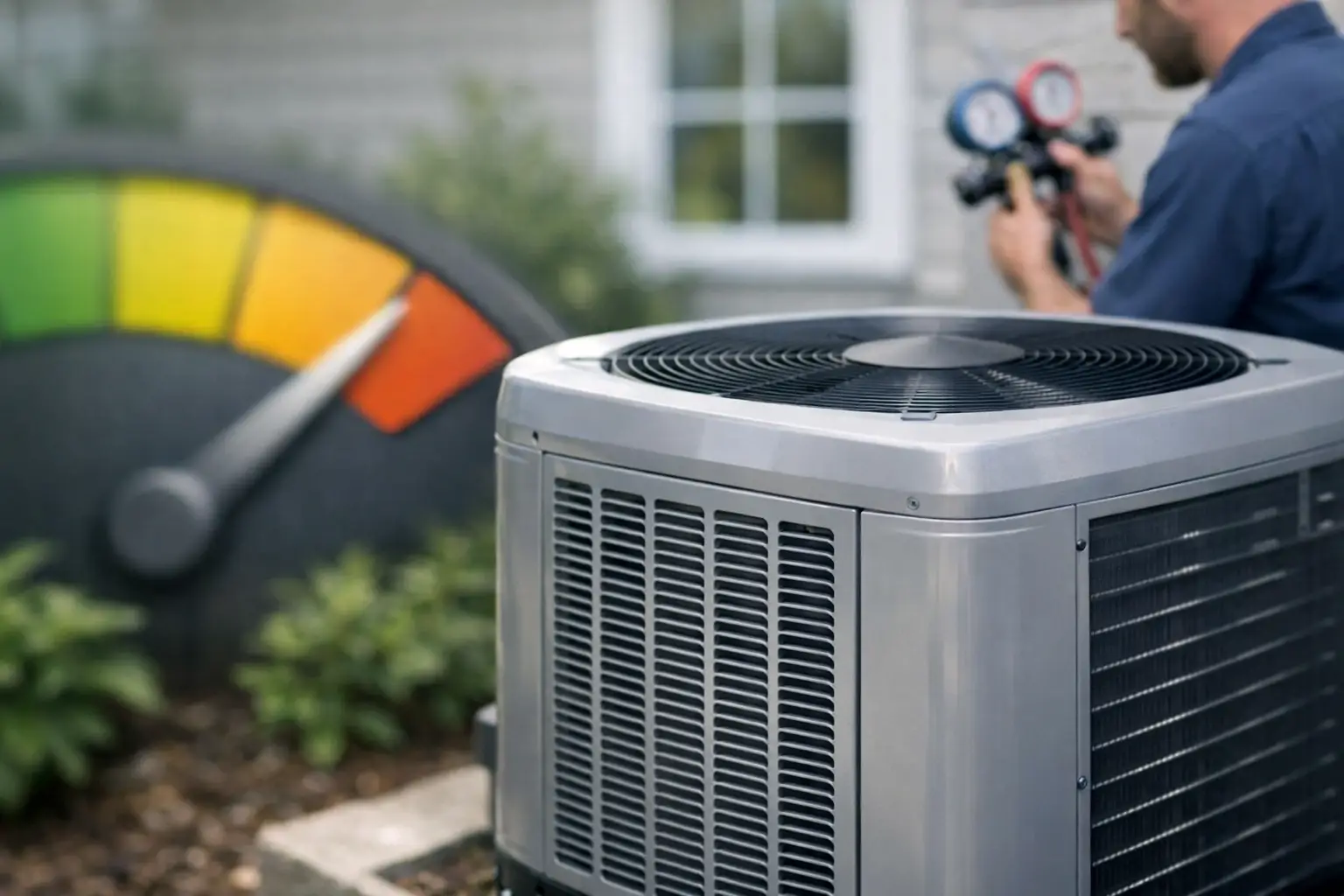
You are comparing air conditioners, and one number keeps showing up on every estimate and spec sheet. If you have asked, what does SEER rating mean, the short answer is this: SEER tells you how efficiently an air conditioner or heat pump cools your home over a typical cooling season. The higher the SEER rating, the less electricity the system should use to produce the same amount of cooling under standard test conditions.
That sounds simple enough, but this is where a lot of homeowners and property managers get pushed toward bigger purchases without the full story. SEER matters, but it is not the only number that matters, and it does not automatically tell you which system is right for your building.
What does SEER rating mean in plain terms?
SEER stands for Seasonal Energy Efficiency Ratio. It measures how much cooling output a system provides compared to how much electrical energy it uses during a season. Think of it as a miles-per-gallon style number for air conditioning. A higher number usually means better efficiency.
If one system has a SEER rating of 16 and another has a SEER rating of 20, the 20 SEER model is generally more efficient. In many cases, that can translate into lower monthly cooling costs. But the real savings depend on how often the system runs, the size of the home or commercial space, local utility rates, insulation levels, duct condition, thermostat settings, and whether the equipment is installed correctly.
That last part is a big one. A high-SEER system with bad airflow, leaking ducts, or incorrect refrigerant charge will not perform the way it should. Efficiency on paper and efficiency in the field are not always the same thing.
Why SEER matters when you shop for HVAC equipment
SEER matters because cooling costs add up fast in North Carolina, especially during long hot stretches. If your AC runs hard for months at a time, even modest efficiency gains can make a difference over the life of the equipment.
It also matters because newer systems are built to meet higher efficiency standards than older units. If you are replacing a 10 SEER or 12 SEER system, almost any modern replacement is likely to be more efficient. That can reduce energy use and improve comfort, especially if the old equipment has wear issues or airflow problems.
Still, chasing the highest rating on the market is not always the smart move. A more expensive high-efficiency system may take years to pay back, and sometimes the extra cost is not justified for the building, usage pattern, or budget.
SEER vs SEER2 – what changed?
If you have looked at newer equipment, you may have seen SEER2 instead of SEER. SEER2 is a newer testing standard that reflects more demanding real-world conditions, particularly around external static pressure. In practical terms, SEER2 gives a more realistic view of system efficiency than the older SEER test.
That does not mean older SEER numbers were fake. It means the industry changed the test to better reflect actual operating conditions. When comparing systems, make sure you are comparing the same standard. A SEER rating and a SEER2 rating are not interchangeable numbers.
For most property owners, the takeaway is simple: focus less on the label itself and more on whether the equipment meets current efficiency standards, fits the space, and is being matched and installed properly.
What does SEER rating mean for your electric bill?
In general, a higher SEER rating can lower your cooling costs. But the amount depends on your specific situation.
If your current system is very old, poorly maintained, or struggling with major performance issues, moving to a properly sized modern unit can produce noticeable savings. If your existing system is already fairly efficient and your cooling demand is moderate, the savings from jumping to a very high SEER model may be smaller than sales presentations make them sound.
For example, a homeowner in Charlotte with an aging low-efficiency unit that runs almost nonstop in July and August may see meaningful operating cost improvements from a mid-range or high-efficiency replacement. A light-use property or a smaller commercial space with limited cooling hours may not see the same return.
This is why honest HVAC advice should start with load calculation, system condition, ductwork, and usage patterns – not just the biggest efficiency number on the brochure.
Higher SEER does not always mean better value
This is where people get tripped up. Higher SEER usually means more advanced equipment, and more advanced equipment often costs more upfront. Sometimes that higher cost is worth it. Sometimes it is not.
A higher-SEER system can make sense if you plan to stay in the property for a long time, your utility costs are high, your current system is outdated, or comfort is a major concern. Many high-efficiency systems also come with features like variable-speed blowers or two-stage operation, which can improve humidity control and temperature consistency.
But there are trade-offs. More complex systems may cost more to repair. Some replacement parts can be more expensive. In certain buildings, especially if ductwork is poor or the envelope is inefficient, spending more on top-tier equipment before fixing the basics may not give you the return you expect.
That is why a good contractor should explain options, not steer every customer toward the most expensive unit.
The installation matters as much as the rating
This point cannot be overstated. SEER is a lab-tested efficiency rating. Your actual performance depends heavily on installation quality.
A correctly installed 15 or 16 SEER system can outperform a poorly installed 20 SEER system in the real world. If the equipment is oversized, it may short cycle and leave humidity behind. If it is undersized, it may run constantly and struggle on peak days. If the duct system leaks or airflow is restricted, the unit will not hit its intended performance.
Proper refrigerant charge, airflow setup, thermostat calibration, drainage, electrical setup, and equipment matching all affect efficiency and reliability. This is one reason technician-led HVAC companies tend to give better long-term recommendations than sales-first companies. The rating matters, but the system as a whole matters more.
When SEER should influence your decision most
SEER should carry more weight when you are replacing an older system, managing high summer utility bills, or trying to reduce cooling demand in a property you plan to keep for years. It also matters more in homes and buildings where the AC runs for extended periods and where comfort problems like high indoor humidity are part of the equation.
It should carry less weight when the main issue is a repairable failure in an otherwise serviceable system. If a capacitor, contactor, blower motor, or coil issue is the real problem, replacement based only on efficiency sales talk may be premature. In plenty of cases, fixing the actual fault is the smarter move.
That is the part many customers appreciate once someone explains it clearly. Not every HVAC problem is a replacement conversation.
A better question than “what SEER should I buy?”
A more useful question is, what system is properly matched to this building, this budget, and this usage pattern?
For some customers, that answer is a dependable mid-efficiency unit that lowers power use without driving up the initial investment too much. For others, especially those prioritizing comfort, humidity control, or long-term operating savings, a higher-efficiency system may make solid sense.
The right answer should come from a real evaluation of the property. That means checking equipment condition, measuring performance, reviewing ductwork, and looking at whether repair or replacement is actually justified. At DDL Services, that kind of straight answer matters because people deserve to know whether they need a fix, an upgrade, or simply better system matching.
What homeowners and commercial operators should remember
If you remember one thing, let it be this: SEER is an efficiency rating, not a guarantee of comfort, savings, or value by itself. It is useful, but it is only one piece of the decision.
A good HVAC choice balances efficiency, installation quality, repair history, building needs, and budget. That is how you avoid overpaying for features you do not need or hanging onto equipment that is costing you more than it should.
When an estimate includes a SEER number, do not be afraid to ask what that number actually means for your property, your operating costs, and your long-term maintenance. A contractor worth trusting should be able to answer that in plain English and without turning the conversation into a sales pitch.
The best HVAC decision is usually not the flashiest one. It is the one that solves the real problem and keeps your home or business comfortable for the right reasons.