

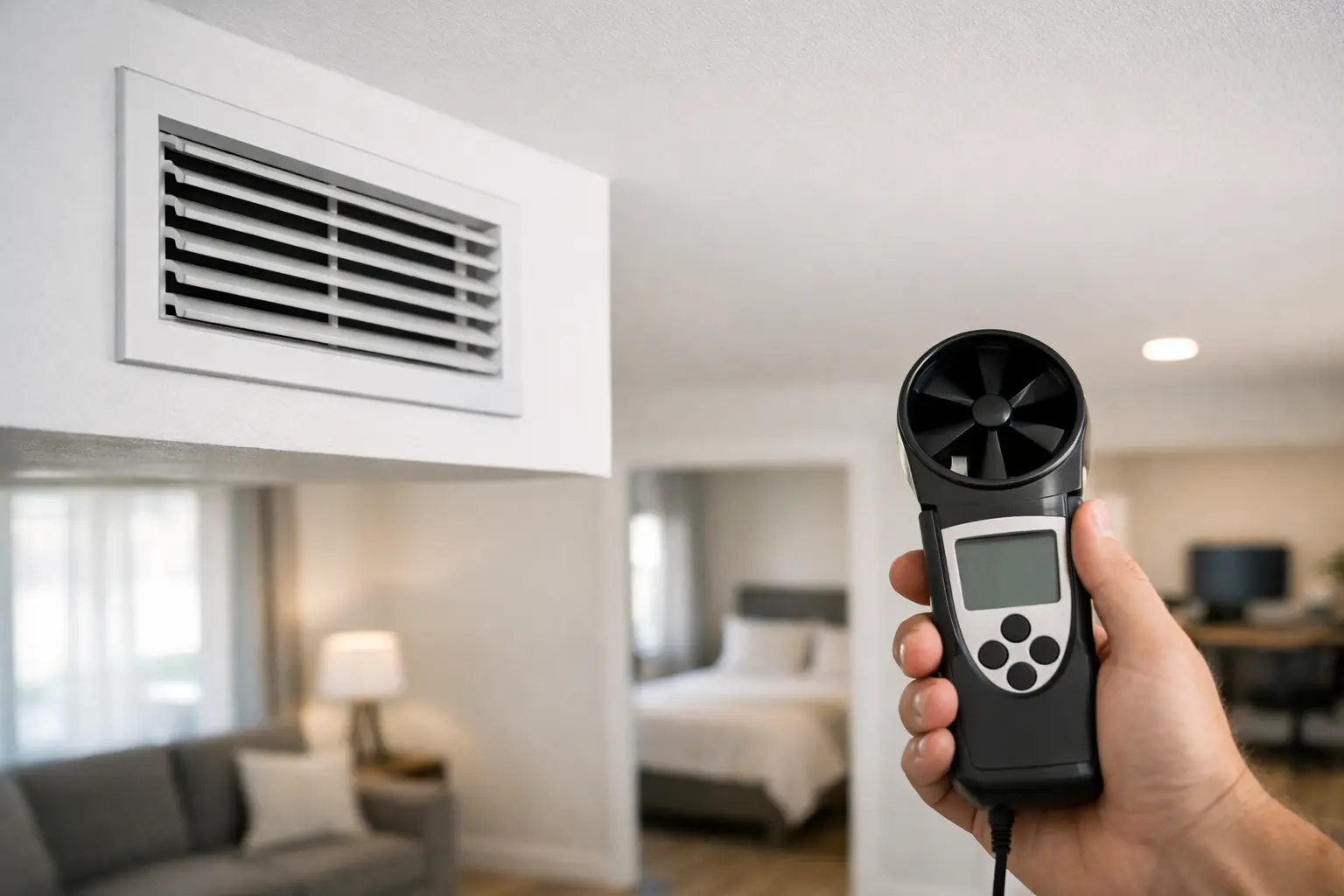
A bedroom that stays warm while the thermostat says 72 degrees is not always an air conditioner problem. It is often an airflow problem. Air balancing explained simply means making sure each room receives the right amount of conditioned air and that the system has a clear path to pull air back. When supply and return airflow are out of balance, comfort becomes uneven, humidity can rise, and HVAC equipment may work harder than it should.
For Charlotte-area homes and businesses, this matters through every season. Long, humid summers expose weak airflow quickly, while winter can make a cold upstairs room or drafty office impossible to ignore. The answer is not automatically a new system. A proper diagnosis should identify whether the issue comes from ducts, equipment settings, insulation, air leakage, or a combination of problems.
What Air Balancing Actually Means
Your HVAC system moves a measured amount of air. The blower pushes conditioned air through supply ducts and into rooms, then pulls room air back through return ducts to be heated or cooled again. Air balancing is the process of measuring and adjusting that airflow so the system distributes comfort as evenly and efficiently as the building allows.
A technician may measure airflow at registers, inspect duct runs, check static pressure, verify blower performance, and look for restrictions in the return path. The goal is not to force every register to blow with identical strength. A large, sunny living room with several windows needs more cooling than a small interior hallway. Good balancing accounts for the actual load of each space.
It also considers pressure. A room with a supply vent but no adequate return path can become pressurized when its door is closed. That air has nowhere easy to go, so less conditioned air enters the room. You may notice the room is stuffy, warmer than the rest of the house, or difficult to cool at night.
Signs Your System May Need Air Balancing
Uneven temperatures are the most obvious sign, but they are not the only one. If you keep changing the thermostat to make one room comfortable, the system is already telling you something is off. Some problems are seasonal. A bonus room may be hot every summer because it sits over a garage, while a room at the end of a long duct run may feel cold during heating season.
Other common signs include weak airflow from certain vents, doors that move or whistle when the system runs, rooms that feel humid despite the AC operating, and unusually high utility bills. In a commercial building, employees may complain about one office freezing while another never cools down. These issues can affect comfort, but they can also point to wasted energy and unnecessary equipment strain.
A dirty filter can reduce airflow throughout the system, but it is rarely the full explanation for one stubborn room. The same is true of a blocked register. Those are worthwhile checks, yet persistent comfort problems deserve a closer look before anyone recommends replacing the unit.
What Causes Uneven Airflow?
Airflow problems are usually caused by more than one factor. An older home may have undersized ducts and poor attic insulation. A newer home may have a well-sized system but a restrictive return grille, closed dampers, or a room addition that was never properly accounted for.
Duct design is a frequent issue. Long runs, sharp turns, crushed flex duct, disconnected joints, and duct leaks all reduce the amount of air reaching a room. Leaky ducts in an attic or crawlspace can waste conditioned air before it ever reaches the living area. At the same time, an undersized return duct can starve the blower for air and raise static pressure across the system.
Equipment settings matter too. A blower speed that is too low may not move enough air through the home. A speed that is too high can create noise, pressure issues, and poor moisture removal in cooling mode. In humid North Carolina weather, humidity control is part of comfort. More airflow is not always better airflow.
The building itself also has a vote. Heat gain from uninsulated attic space, afternoon sun, single-pane windows, gaps around doors, or a room over a garage can overwhelm the airflow that room receives. Air balancing can improve distribution, but it cannot fully solve a major insulation or air-sealing problem by itself. Honest recommendations account for both the HVAC system and the space it serves.
How Technicians Perform Air Balancing
A real air balancing visit starts with questions. Which rooms are uncomfortable? Does the issue happen only when doors are closed? Is it worse in the afternoon, during extreme heat, or all day? Those details help separate a duct issue from a heat-gain issue or a thermostat problem.
The technician should then inspect the basics: filter condition, coil cleanliness, blower operation, supply and return grilles, duct condition, and accessible dampers. Measuring static pressure is especially valuable because it shows how hard the blower is working to move air through the system. High static pressure can signal restricted ducts, an undersized return, a clogged coil, or an overly restrictive filter setup.
Airflow measurements at supply registers show where air is going and where it is falling short. Dampers may be adjusted to redirect some air from over-conditioned areas to rooms that need more. This has limits. Closing several registers to push air elsewhere can increase pressure and cause new problems, particularly in systems that were already struggling for return airflow.
A technician may also check whether rooms have a return grille, a transfer grille, or enough door undercut for air to travel back to the central return. In some cases, adding a return path is more effective than adjusting supply vents. In others, duct repair, duct resizing, insulation improvements, zoning, or a properly selected ductless unit may be the practical answer.
Air Balancing Explained for Two-Story Homes
Two-story homes are among the most common places to see comfort complaints. Heat naturally rises, upper floors often receive more sun exposure, and upstairs ductwork may run through hot attic space. One thermostat located downstairs cannot always reflect what is happening in second-floor bedrooms.
Before adding expensive equipment, check for simple causes such as closed dampers, blocked returns, leaking attic ducts, or an incorrect blower setting. If the existing system is properly sized but cannot control two distinct areas with one thermostat, zoning may help. A zoning system uses dampers and separate temperature controls to direct airflow where it is needed. It can be effective, but it must be designed around the equipment and duct capacity. Adding zones to an already restrictive duct system without correcting the restriction can create pressure problems.
For a finished room over a garage, the right answer may include duct adjustments plus better insulation and air sealing below the floor. The HVAC system should not be asked to compensate forever for a space that is gaining or losing heat too quickly.
Commercial Air Balancing Is About Comfort and Operations
In a small office, retail space, restaurant, or medical practice, inconsistent airflow affects more than comfort. Hot and cold spots can lead to employee complaints, unhappy customers, humidity concerns, and uneven wear on equipment. A conference room that fills with people has a different cooling load than a storage area, and a south-facing storefront has different needs than an interior office.
Commercial balancing often involves verifying rooftop unit airflow, supply diffuser performance, return-air paths, outside-air settings, and the condition of ductwork. Buildings that have been renovated or divided into new rooms may have airflow patterns that no longer match how the space is used. A practical review can reveal whether adjustments and repairs are enough or whether the layout requires a more substantial correction.
What Homeowners Can Check First
Start with the low-risk items. Make sure supply registers and return grilles are open and not covered by furniture, rugs, or curtains. Replace a dirty filter with the correct size and type for the system. Check that accessible manual dampers have not been accidentally closed, especially after past service or renovations.
Do not close multiple vents throughout the house in an attempt to force air upstairs or into one room. That common shortcut can raise system pressure and reduce overall performance. Avoid covering returns as well. Your HVAC system needs both a way to deliver air and a way to bring it back.
If the issue continues, document when it happens and which rooms are affected. That information gives a technician a better starting point and helps prevent guesswork.
When Balancing Is Not Enough
Air balancing can improve many comfort problems, but it cannot correct failed equipment, severely undersized ductwork, major refrigerant issues, or a system that was incorrectly sized from the beginning. It also will not eliminate heat gain from a poorly insulated room without addressing the building envelope.
That does not mean replacement is the first answer. DDL Services approaches airflow complaints by finding the actual restriction or imbalance first. Sometimes the fix is a duct repair, return-air improvement, blower adjustment, or targeted insulation recommendation. If equipment replacement is truly warranted, the new system should be matched to the home or business and its duct system, not selected as a quick sales answer.
A comfortable building is not one where the thermostat runs constantly. It is one where air can move where it needs to go, rooms can return air properly, and the equipment is not fighting avoidable restrictions. If one area never feels right, treat it as a diagnostic question, not a reason to keep turning the thermostat lower.