

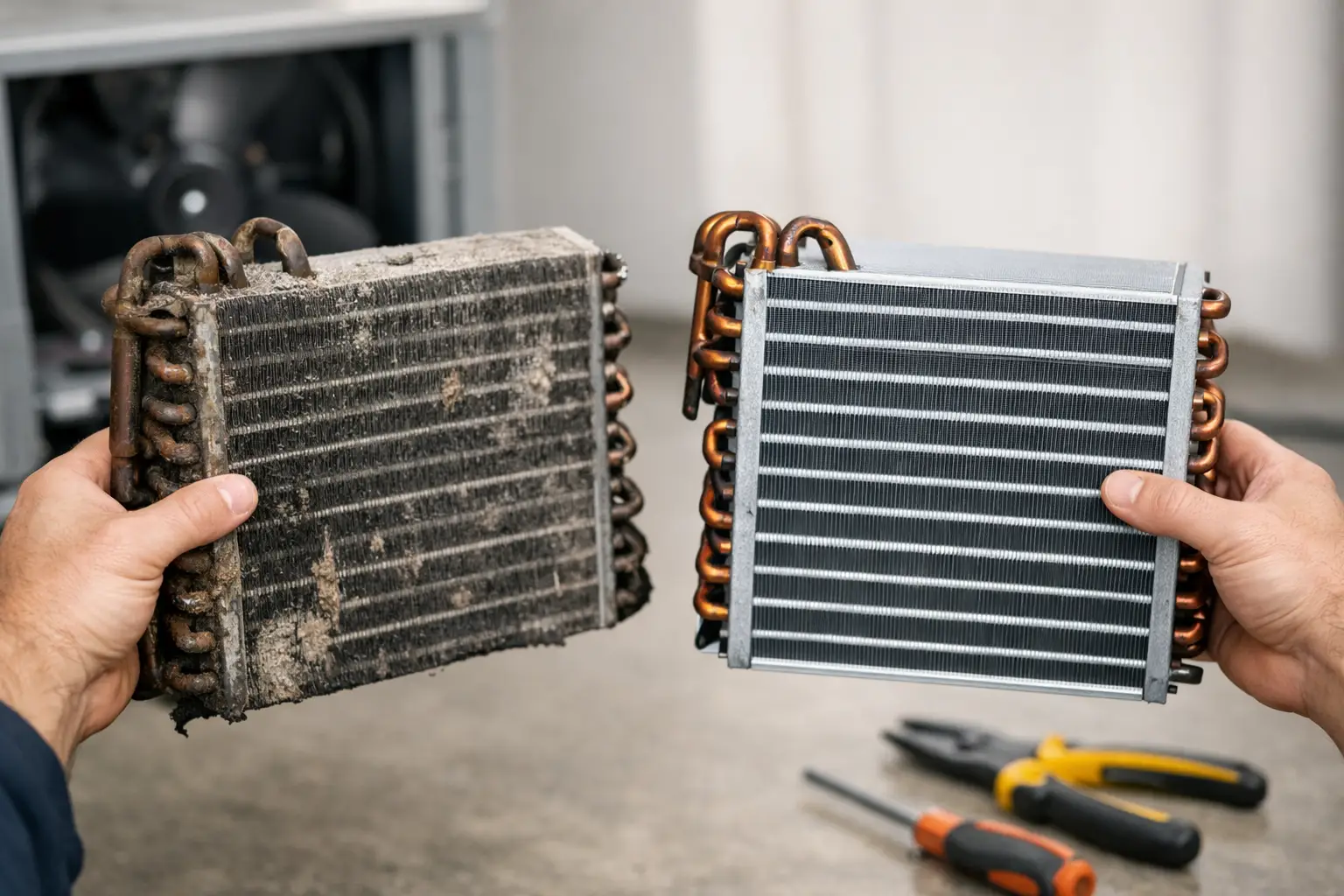
A leaking evaporator coil can turn a simple cooling complaint into a very expensive conversation fast. If you are being told to repair or replace evaporator coil components, the right answer is not always the most expensive one. Sometimes a coil repair buys you useful time. Sometimes replacement is the only practical move. The key is knowing which situation you are actually dealing with.
Too many property owners get pushed straight toward full system replacement before anyone explains what failed, why it failed, and whether the issue is isolated to the coil. A good diagnosis should come first. That matters whether you are dealing with a home AC that cannot keep up in a Charlotte summer or a light commercial system that is affecting comfort, inventory, or business operations.
What the evaporator coil actually does
The evaporator coil sits inside your indoor unit and absorbs heat from the air moving through your system. As refrigerant passes through the coil, it pulls heat and humidity from the indoor air. That is one of the main reasons your AC cools the space and helps control moisture.
When the coil develops a problem, comfort drops quickly. You may notice warm air from the vents, weak cooling, higher humidity, longer run times, or ice forming on the refrigerant lines. In some cases, the issue starts small and gets worse over time. In others, a leak or failure becomes obvious almost overnight.
When repair makes sense
There are cases where repairing the evaporator coil is reasonable. If the problem is limited, the system is not too old, and the rest of the equipment is in good shape, a repair can be the smartest financial decision.
For example, if the issue is related to a valve, fitting, brazed joint, or accessible leak point outside the main body of the coil, repair may be possible. The same goes for situations where airflow problems caused icing but the coil itself is still structurally sound. A dirty filter, blocked return, blower issue, or low refrigerant charge can create symptoms that look like a bad coil even when the real problem is somewhere else.
This is why accurate testing matters. You want to know whether the coil itself is leaking, whether the leak is repairable, and whether the refrigerant circuit can be restored reliably. You also want to know if the unit has had repeat refrigerant loss before. One repair is very different from a pattern of repairs.
When replacing the evaporator coil is the better call
If the coil has multiple leak points, widespread corrosion, or damage in areas that do not lend themselves to a lasting repair, replacement is usually the better path. A patch on a badly deteriorated coil often turns into another service call later.
Age matters too. If the system is already well into its service life, a coil replacement has to be weighed against the condition of the condenser, compressor, blower, and controls. Replacing one major component in an aging system can make sense, but not always. If you are putting significant money into a unit that may soon have another costly failure, that should be explained clearly.
Another factor is refrigerant type. Older systems using phased-out refrigerants can become expensive to maintain. Even if you can replace the coil, the cost of refrigerant and the long-term practicality of keeping the system going may not work in your favor.
Repair or replace evaporator coil: the real decision factors
The question is not just repair or replace evaporator coil parts in isolation. It is whether the repair will hold, whether the cost is justified, and whether the rest of the system still deserves investment.
A technician looking at this honestly should weigh five things. First is the location and severity of the leak or damage. Second is the age of the system. Third is refrigerant type and availability. Fourth is the condition of the outdoor unit and overall system match. Fifth is your budget and how long you plan to keep the property.
If you are in a home you expect to keep for years, a stronger long-term fix may make more sense. If you are managing a commercial space and need to control downtime, the decision may come down to speed, reliability, and operating cost. If you are trying to get another season or two from a system before a planned upgrade, a focused repair may be perfectly reasonable.
Signs the diagnosis needs a second look
If someone recommends replacing the entire system within minutes of arrival, ask more questions. That does not automatically mean the recommendation is wrong, but you should hear a clear explanation of the failure. You should know whether the coil is leaking, where the problem is, how it was tested, and what repair options were considered.
Be cautious if the explanation stays vague. Phrases like the unit is old, these things happen, or you are better off just replacing it are not enough on their own. A technician should be able to tell you what was found and why that finding supports repair, coil replacement, or full system replacement.
That straightforward approach is one reason many local customers choose companies like DDL Services. People want real HVAC solutions, not sales pitches, especially when a major component is involved.
Why evaporator coils fail in the first place
Most evaporator coil failures are not random. Corrosion is one of the biggest causes. Indoor air contaminants can react with the copper or aluminum in the coil over time and create tiny leaks. This is often called formicary corrosion, and it can be difficult to spot without proper testing.
Poor airflow is another common factor. A clogged filter, dirty blower wheel, blocked ductwork, or filthy coil can cause the coil to run too cold and freeze. Repeated freezing and thawing adds stress to the system and can contribute to refrigerant and performance issues.
Improper installation also plays a role. Mismatched equipment, bad brazing practices, incorrect refrigerant charge, and drainage issues can shorten coil life. That is why the quality of the original installation matters just as much as the quality of the repair.
Cost is important, but so is value
Most people asking whether to repair or replace an evaporator coil are really asking a broader question: what is the smartest use of my money right now?
A lower upfront repair cost can still be a poor value if the fix is temporary and another major failure is close behind. On the other hand, a coil replacement may cost less than full equipment replacement and still give you several solid years of service if the system is otherwise in good condition.
This is where honest guidance matters. The cheapest option is not always the most affordable over time, and the most expensive option is not automatically the right one. Good HVAC advice should protect you from both mistakes.
How homeowners and business owners should think about this
For homeowners, comfort, indoor humidity, and electric bills are usually the biggest concerns. If your system is cooling unevenly, running constantly, or losing refrigerant, you need a diagnosis that explains whether the problem is truly the coil or a related issue.
For commercial property operators, the stakes can be different. Downtime affects staff, tenants, customers, and sometimes equipment or product. In those cases, the best answer may lean toward the option that restores dependable operation fastest, even if the upfront cost is higher.
Either way, the decision should be based on the condition of the equipment you have, not on a one-size-fits-all sales script.
What to ask before approving the work
Before you approve a repair or replacement, ask what failed, how the failure was confirmed, and whether the issue is isolated or part of a larger system problem. Ask if the system has other wear that could affect near-term reliability. Ask how the age of the unit and refrigerant type change the recommendation.
You should also ask whether the proposed solution is expected to be a short-term measure or a long-term fix. That answer helps you make a decision based on your goals, not just the estimate in front of you.
A trustworthy HVAC contractor should not have a problem walking you through those answers in plain language. If they cannot explain it clearly, that is a problem on its own.
The right call on an evaporator coil is rarely about selling the biggest job. It is about finding the real problem, weighing the trade-offs honestly, and choosing the fix that makes sense for your equipment, your property, and your budget. When you get that kind of diagnosis, the decision gets a lot easier.