

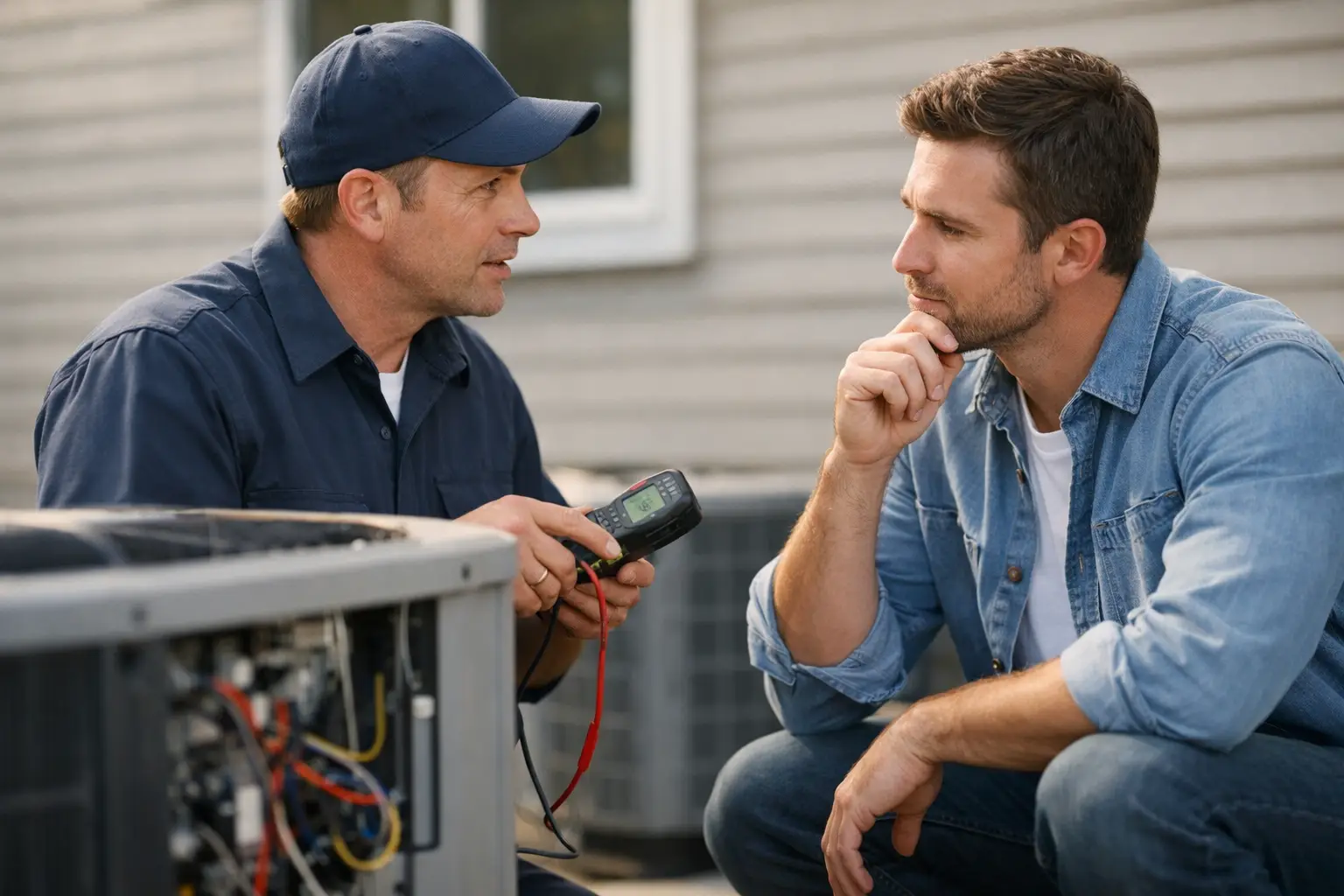
You call for help because the AC is blowing warm air, the heat keeps short cycling, or a rooftop unit at your business suddenly stops doing its job. Then comes the verdict: major repair, expensive parts, or full replacement. That is the moment an HVAC technician second opinion can save you thousands – or confirm that the first diagnosis was right and urgent action is needed.
Not every big recommendation is wrong. Some systems really are at the end of their service life. Some repairs truly do cost more than they are worth. But in HVAC, there is also a real problem with rushed diagnostics and replacement-first sales. If the person standing in front of you moves too fast from symptom to sales quote, it is reasonable to slow the process down and ask another qualified technician to evaluate the system.
Why an HVAC technician second opinion matters
Heating and cooling systems are complicated. Multiple issues can create the same symptom. Low airflow, frozen coils, bad capacitors, refrigerant problems, dirty burners, failed controls, duct restrictions, thermostat issues, and electrical faults can all overlap. If a technician does not test thoroughly, it is easy to treat the wrong problem or recommend replacing equipment that could still be repaired.
A second opinion matters because diagnosis is where the money decision gets made. Once a homeowner or property manager hears, “You need a new system,” the conversation often shifts away from whether that is true. It becomes about financing, brands, and installation dates. That can happen before anyone has clearly explained what failed, what was tested, and whether repair is still a practical option.
A good second opinion does not exist to contradict the first company just for the sake of it. It exists to verify the actual cause, compare repair versus replacement honestly, and give you a clearer basis for deciding what to do next.
Signs you should ask for an HVAC technician second opinion
Sometimes the need is obvious. Sometimes it is more about the way the recommendation is delivered.
If a technician says you need full replacement but cannot clearly explain why, that is a problem. If they use broad phrases like “the unit is shot” or “it is not worth fixing” without test results, part failures, or condition details, you do not have enough information yet.
You should also pause if the diagnosis happens unusually fast. Some failures are easy to identify, but many are not. If someone spends only a few minutes looking at the equipment and then presents a large quote, it is fair to wonder whether they diagnosed the issue or just moved to the most expensive outcome.
Another red flag is when the symptom and the recommendation do not seem to match. For example, an AC that is not cooling does not automatically mean the whole system is bad. It could be airflow, a failed component, thermostat communication, a drain safety switch, or another repairable issue. The same goes for a furnace that will not start. A no-heat call can come from a simple control problem just as easily as a cracked heat exchanger. The details matter.
Age alone is another weak reason. Older equipment may justify caution, but old does not always mean unrepairable. A 12- or 15-year-old unit with one failed part is different from a neglected system with major compressor damage, refrigerant leaks, and poor efficiency. A second opinion helps separate age-based sales pressure from a real end-of-life condition.
What a trustworthy second opinion should include
A real second opinion is not just another estimate. It should begin with diagnosis.
That means the technician should inspect the system, ask about the symptoms, look at service history if available, test key components, and explain what they found in plain language. If the issue involves cooling performance, they may check temperatures, pressures, airflow, electrical readings, filters, coils, drains, controls, and thermostat operation. If it involves heating, they may inspect ignition, gas components, safeties, blower operation, heat exchanger condition, and venting. Commercial systems may also require zoning, controls, economizer, or rooftop package unit checks depending on the setup.
Just as important, the technician should explain what is confirmed versus what is assumed. That distinction matters. Good diagnostics sound specific. They identify the failed part, the system condition around it, and whether there are related issues that affect the repair decision.
You should also expect a balanced conversation about options. If repair is possible, you should hear what it fixes, what it costs, and what risks remain based on the equipment age and condition. If replacement is the smarter choice, the explanation should connect to facts like repeated breakdowns, major component failure, refrigerant type, repair cost relative to system value, or improper equipment sizing.
Repair or replace? It depends on more than one number
Many people want a clean rule, like replace it if the repair costs more than half the value of the system. Real life is messier than that.
The right answer depends on the type of failure, the age of the system, energy performance, warranty status, condition of the ductwork, past repair history, and how critical the equipment is to your home or business. A relatively expensive repair may still make sense on a system that has been reliable, is properly sized, and has several useful years left. On the other hand, even a moderate repair may not be wise on equipment with chronic issues, obsolete refrigerant, or signs of poor installation.
For commercial clients, downtime changes the equation. A business might accept replacement sooner if recurring service calls disrupt operations, affect customers, or create tenant complaints. For homeowners, comfort and predictability often matter just as much as efficiency. If you have young children, aging family members, or indoor air quality concerns, reliability may weigh heavily in the decision.
This is where an honest contractor stands out. The goal should not be to force repair or push replacement. It should be to explain the trade-offs clearly enough that the customer can make a sound decision.
How to ask for a second opinion without wasting time
You do not need to turn it into a confrontation. Just gather information.
Ask the first company what they found, what tests they performed, which parts failed, and why they recommend repair or replacement. Request the model and serial number of the equipment and a written estimate. If they noted refrigerant leaks, compressor failure, electrical damage, cracked heat exchanger concerns, or airflow problems, ask them to put that in writing.
Then call another licensed HVAC contractor and explain that you want diagnosis, not just a quote. Tell them the symptoms and share the first recommendation, but do not lead them too hard toward agreeing or disagreeing. Let them evaluate the equipment independently.
If the system is unsafe, do not ignore that while shopping around. A suspected cracked heat exchanger, serious electrical issue, burning smell, or equipment that repeatedly trips breakers needs prompt attention. A second opinion should be fast and informed, not delayed for days while the risk gets worse.
What to watch for during the second visit
The technician should be able to answer straightforward questions without getting defensive. What failed? How do you know? Can it be repaired? If you recommend replacement, what makes repair a poor choice here?
Clarity matters more than technical jargon. If the explanation is simple, specific, and backed by actual findings, that is a good sign. If the conversation quickly shifts to monthly payments, promotional offers, or urgency without evidence, that is not.
It also helps to pay attention to whether the proposed solution matches the building. In homes and small commercial spaces, proper sizing and installation quality are just as important as the equipment itself. A second opinion that only talks about brand names but ignores duct issues, airflow, insulation, controls, or system matching is incomplete.
That is one reason many customers in the Charlotte area look for technician-led companies rather than sales-led ones. DDL Services has built its reputation around finding the actual problem first and recommending replacement only when it truly makes sense.
The real value of a second opinion
An HVAC technician second opinion is not about distrusting every contractor. It is about protecting yourself when the stakes are high. Heating and cooling decisions can affect your budget, comfort, energy use, and business operations for years.
Sometimes the second opinion confirms the first one, and that peace of mind is worth a lot. Sometimes it uncovers a repairable issue that was missed. Sometimes it changes the recommendation from immediate replacement to practical repair now and planned replacement later. All three outcomes are useful because they are based on better information.
If something about the diagnosis feels rushed, vague, or too focused on selling, trust that instinct and ask more questions. A good contractor will never object to an informed customer. When the explanation is honest and the diagnosis is sound, the right decision usually becomes a lot easier.