

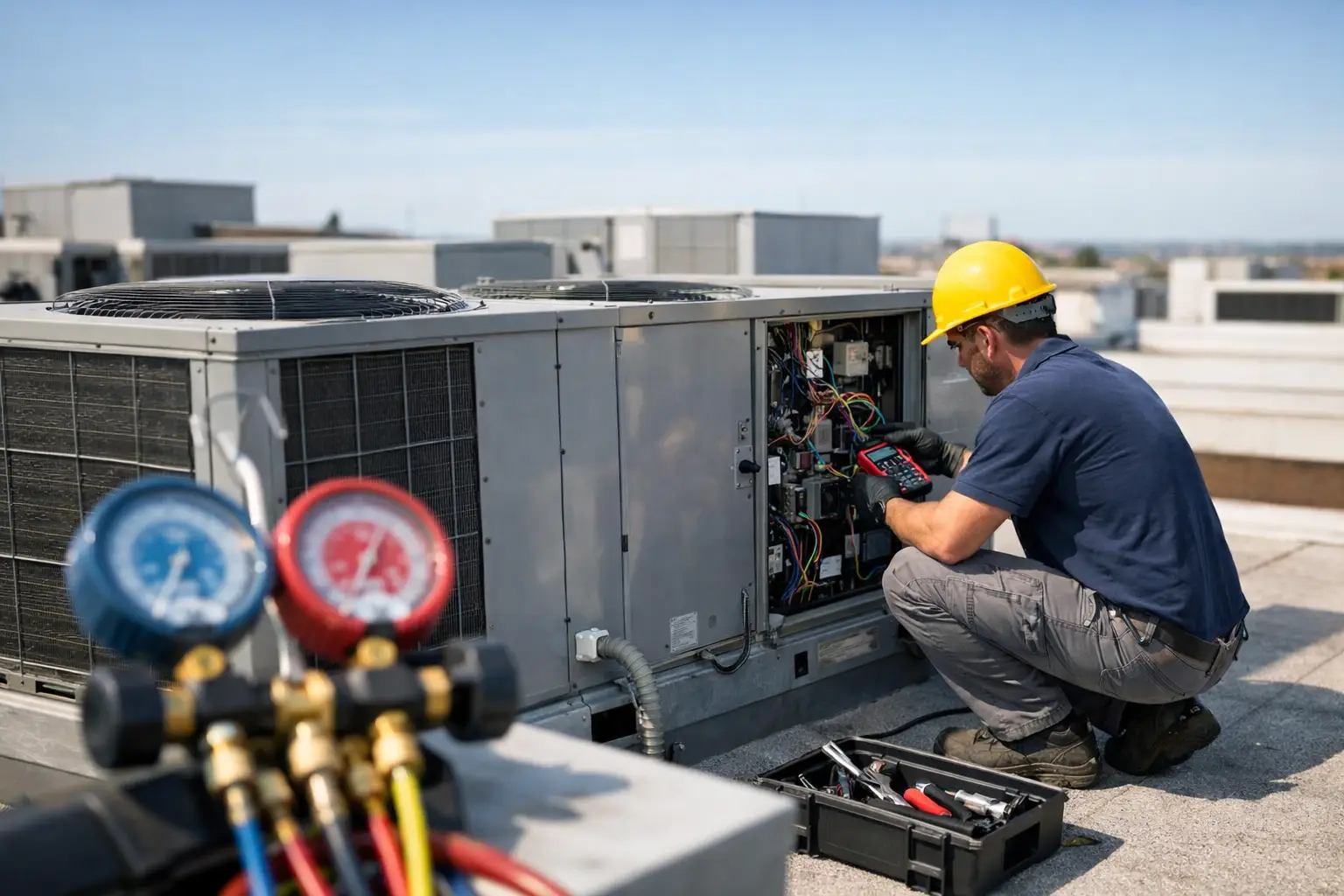
A restaurant opens at 11, the dining room is already warming up by 9, and the rooftop unit is short cycling again. That is usually when commercial rooftop unit repair stops being a line item and becomes an operational problem. When an RTU starts missing temperature, tripping safeties, or running nonstop, every hour of delay affects comfort, equipment life, and in some businesses, revenue.
For small and mid-sized commercial properties, the real issue is not just getting cooling or heat back on. It is figuring out whether the unit has a repairable fault, a maintenance-related problem, or a larger system condition that keeps causing repeat breakdowns. That distinction matters because too many service calls jump straight to replacement talk before the actual cause is pinned down.
Why commercial rooftop unit repair needs real diagnosis
Rooftop units are built to handle a lot, but they are not simple boxes that either work or do not. An RTU combines refrigeration components, electrical controls, airflow management, gas heat in many cases, and economizer functions. A failure in one area can look like a failure somewhere else.
A bad capacitor might resemble a failing motor at first glance. A dirty condenser coil can drive high head pressure and cause nuisance shutdowns that get blamed on the compressor. Low airflow across the evaporator can lead to freezing, poor cooling, and uncomfortable indoor humidity, even when the refrigerant charge is technically close. If a technician skips the testing and goes straight to a major recommendation, the customer can end up paying for the wrong fix.
That is why commercial work has to start with facts. Voltage, amperage, pressure readings, temperature split, airflow condition, control response, and heat exchanger or burner performance all have to be checked in context. Good repair work is not guesswork. It is a process of ruling things in and out until the root cause is clear.
Common problems behind rooftop unit failures
A lot of RTU issues come down to a handful of recurring failures, but the symptoms do not always point cleanly to the source. Electrical problems are common, especially with contactors, capacitors, relays, fuses, and wiring connections that have deteriorated from heat and vibration. A unit may fail to start, start and stop rapidly, or run one section of the system while another stays offline.
Airflow issues are just as common. Dirty filters, plugged evaporator coils, failing blower motors, damaged belts in belt-driven systems, or economizer dampers stuck in the wrong position can all cause comfort complaints and efficiency loss. In retail, office, and light industrial spaces, those airflow problems often show up first as uneven temperatures and humidity swings rather than a total shutdown.
Refrigeration problems can be more expensive, but they still require careful diagnosis. Low charge, restrictions, metering device issues, or a weak compressor can create similar symptoms. The right response depends on the condition of the whole circuit. Simply adding refrigerant without finding a leak is not a repair. It is a temporary delay.
Gas heat sections bring another set of concerns. Ignition failures, flame sensing issues, pressure switch faults, and cracked heat exchangers can all interrupt heating operation. Some of those are straightforward repairs. Some are serious safety problems that call for a different conversation.
When a repair makes sense and when it does not
Most business owners do not want a sales pitch. They want to know what can be fixed, what should be fixed, and what is likely to fail next. That is a reasonable expectation.
In many cases, commercial rooftop unit repair is the right move. If the unit has a failed capacitor, contactor, inducer motor, blower component, ignition part, sensor, or accessible control issue, a focused repair can restore reliable operation without forcing a major capital expense. The same is true for coil cleaning, drain correction, economizer adjustment, and many airflow-related problems.
It gets more complicated when the compressor is failing, the heat exchanger is compromised, the refrigerant circuit has a significant leak, or the cabinet and internal components show widespread age and deterioration. At that point, repair may still be possible, but it may not be the smartest investment. The answer depends on the age of the unit, refrigerant type, repair cost, operating history, and how critical the space is.
This is where honest guidance matters. A ten-year-old rooftop unit with a single repairable electrical failure is not the same as a twenty-year-old unit with recurring cooling problems, rusted structure, poor efficiency, and obsolete parts. Lumping both into the same recommendation does not help the customer make a good decision.
What a solid commercial rooftop unit repair visit should include
A proper service visit should leave you with more than a restored thermostat setting. You should know what failed, why it failed, and whether the repair addressed the cause or just the symptom.
That means the technician should inspect the unit condition, test controls, verify motor and compressor operation, check coils and filters, review safeties, and confirm system performance after the repair. If the problem is linked to lack of maintenance, airflow restriction, dirty components, or an economizer issue, that should be explained clearly. If there are signs of larger wear, those should be documented without turning the visit into pressure selling.
For facility managers and business owners, communication is part of the repair. If a unit is back online but the condenser coil is heavily impacted and likely to cause another high-pressure fault, you need to know that. If a repair is viable but parts availability is becoming a concern due to equipment age, that matters too. Clear information helps you budget and plan instead of reacting to the next emergency.
Why repeat breakdowns happen after repair
Not every repeat call means the first repair was wrong, but repeat failures usually point to something unresolved. Sometimes one failed part was only the first visible symptom of a larger issue. A burned contactor may have been caused by voltage imbalance, excessive amperage draw, or a compressor under strain. A failed blower motor may trace back to dirty coils, airflow restriction, or weak maintenance practices that pushed the motor beyond normal load.
Environmental exposure also plays a role. Rooftop equipment deals with direct sun, rain, debris, and wide temperature swings. In the Charlotte area, summer heat and long cooling seasons put extra stress on condensers, motors, and controls. If units are not cleaned and inspected regularly, minor wear becomes a bigger repair faster than many operators expect.
That is one reason preventative maintenance has real value in commercial settings. Not because it prevents every issue, but because it catches weak components, coil contamination, drainage problems, and control faults before they turn into downtime during business hours.
How to protect your building after an RTU repair
Once the immediate issue is fixed, the next step is reducing the chance of another disruption. That usually starts with a realistic look at maintenance intervals, filter changes, coil condition, and how the equipment is actually being used. A unit serving a restaurant, salon, server room, or high-traffic retail space may need more attention than one serving a lightly occupied office.
It also helps to track service history. If the same unit keeps losing cooling, tripping on limit, or showing economizer problems, patterns matter. Those patterns can reveal whether the problem is isolated or part of a bigger decline in equipment condition.
For many commercial customers, the best service partner is the one willing to repair what is repairable and say so plainly when a unit has reached the point where replacement deserves serious consideration. That balance matters. You do not want to replace a unit too early, and you do not want to keep funding repairs that no longer make business sense.
At DDL Services, that practical approach is the point. Commercial customers need straight answers, accurate diagnostics, and repairs that solve the real problem instead of creating a bigger bill without a better outcome.
Choosing the right contractor for commercial rooftop unit repair
Commercial HVAC service should feel measured, not rushed. You want a contractor who understands controls, airflow, refrigeration, and heat sections as a complete system, not someone looking for the fastest path to a replacement quote.
Ask how the problem was verified. Ask what readings support the diagnosis. Ask whether the repair addressed the cause or only the failed component. A reputable contractor should be comfortable answering those questions in plain language.
The best repair decisions come from clear testing, honest communication, and a willingness to fix what can be fixed. When your rooftop unit goes down, that is what keeps the call focused on your building, your budget, and the actual condition of the equipment – not on a sales script.