

A system can be cooling the house and still be working far harder than it should. That is where static pressure testing benefits homeowners and business owners: it shows whether the blower can actually move air through the duct system without excessive resistance. Instead of guessing why certain rooms stay uncomfortable, why filters get dirty quickly, or why an AC keeps freezing up, a technician can measure the problem.
Static pressure is not a sales tool or a reason to condemn equipment. It is a diagnostic measurement that helps identify the real cause of airflow trouble. For Charlotte-area homes and commercial spaces, where air conditioners carry a heavy load through long, humid summers, that information can prevent wasted energy, repeated repairs, and premature equipment replacement.
What Static Pressure Testing Measures
Your HVAC blower is designed to move a specific volume of air against a limited amount of resistance. Every part of the air path adds some resistance: the filter, return grille, ductwork, evaporator coil, supply registers, dampers, and accessories such as UV lights or air cleaners.
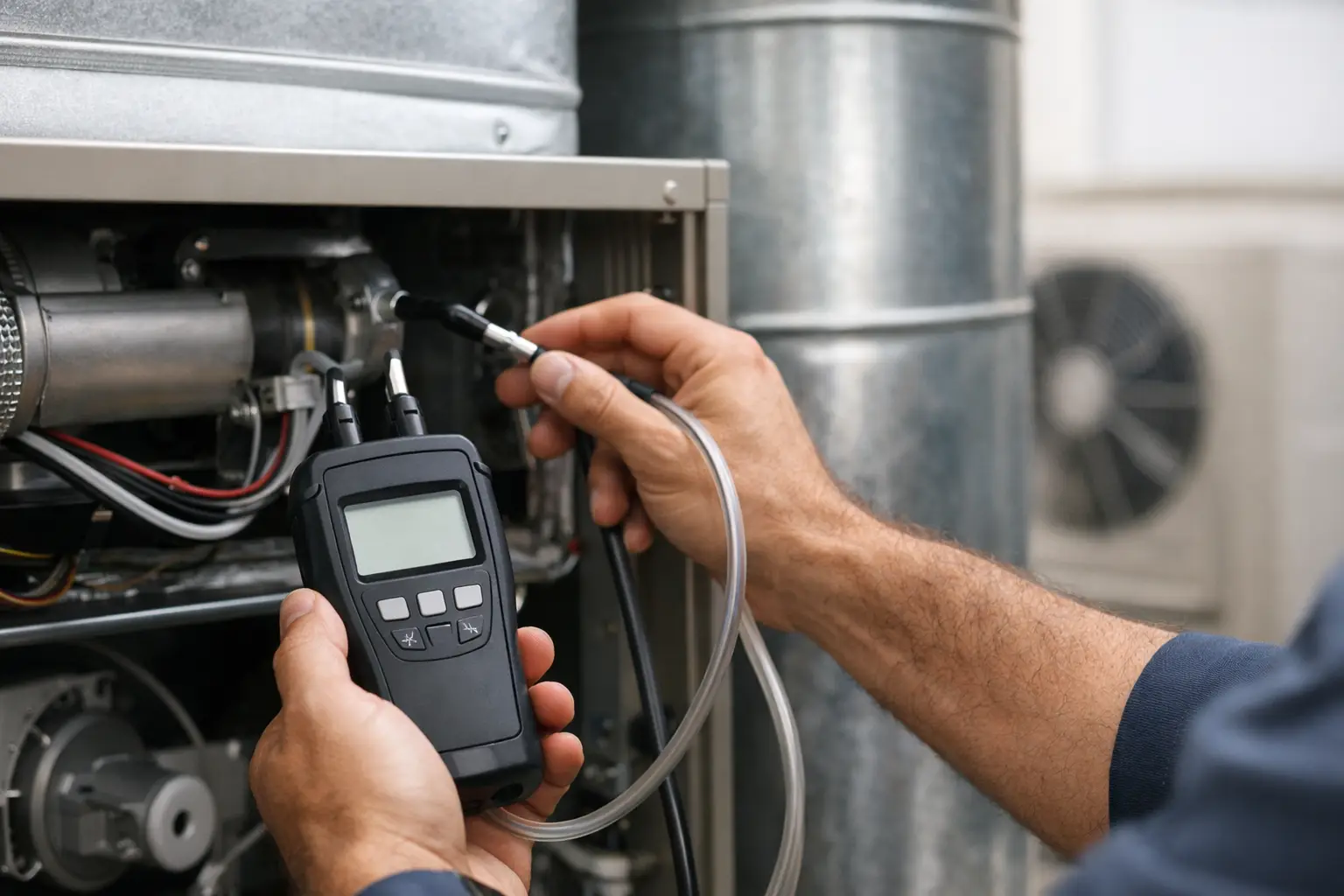
Static pressure testing measures that resistance. A technician uses a calibrated manometer to take pressure readings at key points around the air handler or furnace. Those readings are compared with the equipment manufacturer’s allowable total external static pressure rating.
Think of it like checking blood pressure rather than simply listening for a heartbeat. The system may be running, but the readings can show that air is being forced through a restriction that is putting strain on the equipment. High static pressure usually means the system is fighting to move air. Low pressure in the wrong location can point to leaks, disconnected ducts, or return-air problems.
Static Pressure Testing Benefits That Matter
The value of testing is not the number alone. It is what that number allows a qualified technician to diagnose and correct.
It finds airflow problems that are easy to miss
Many HVAC complaints overlap. A weak airflow complaint could come from a clogged filter, a dirty evaporator coil, undersized return ducts, a failing blower motor, closed dampers, crushed flex duct, or supply ducts that were never sized correctly. Replacing a thermostat or adding refrigerant will not fix a duct restriction.
Static pressure testing narrows the search. By measuring pressure before and after components such as the filter and coil, a technician can identify where the resistance is building. That leads to a repair based on evidence rather than a guess.
It protects comfort in every room
High static pressure often shows up as uneven temperatures. The thermostat may satisfy quickly while bedrooms, upper floors, offices, or back rooms remain warm. In heating season, the same issue can leave distant rooms chilly even though the furnace is running.
A properly operating duct system gives conditioned air a clear path to travel out and return to the equipment. Testing can reveal whether a lack of return air, restrictive duct runs, or incorrectly adjusted dampers are contributing to comfort issues. The solution may be as simple as removing an overly restrictive filter, or it may require duct modifications. The right answer depends on the readings and the building.
It can reduce unnecessary wear on equipment
When static pressure is too high, the blower works under added strain. Reduced airflow across an air conditioner’s evaporator coil can contribute to coil freezing and poor humidity control. It can also make the compressor work longer to reach the thermostat setting.
On a furnace, restricted airflow can cause the heat exchanger to run hotter than intended and trigger safety limits. Those shutdowns can look like an equipment failure when the root problem is airflow. Addressing the restriction early can reduce stress on motors, controls, compressors, and heat-related components.
It supports real efficiency improvements
High utility bills are not always caused by old equipment. A newer, high-efficiency system connected to poorly designed ductwork can still waste energy and disappoint the owner. Equipment efficiency ratings assume that the system receives proper airflow under appropriate operating conditions.
Static pressure testing helps confirm whether the duct system is allowing the equipment to perform as designed. It does not guarantee a certain energy bill, since insulation, thermostat settings, outdoor temperatures, occupancy, and system condition all matter. But it can identify an avoidable source of energy waste before someone is pushed toward replacing an otherwise repairable unit.
It helps prevent bad replacement decisions
A system that short cycles, freezes, overheats, or delivers poor airflow may need repair, duct correction, or maintenance – not necessarily a new unit. This distinction matters because replacing the outdoor unit alone will not correct undersized returns or a clogged coil. In some cases, a new system installed on the same restrictive ductwork can suffer the same problems from day one.
Testing provides a baseline for an honest recommendation. If the equipment is near the end of its useful life and the ductwork is also restrictive, a replacement plan may make sense. If the pressure issue is caused by a dirty coil or a filter that is too restrictive for the system, the repair may be far more straightforward.
Common Causes of High Static Pressure
A dirty filter is the most familiar cause, but it is not the only one. Some high-MERV filters provide excellent filtration while creating more resistance than a particular system can handle. The right filter choice should balance indoor air quality needs with the blower and duct system’s capacity.
Dirty indoor coils are another common issue, especially when routine maintenance has been skipped. Dust bypassing a poor-fitting filter can accumulate on the coil and restrict air movement. A technician should also inspect the blower wheel, which can collect debris and lose its ability to move air effectively.
Duct design can be the larger issue. Older homes, additions, renovations, and equipment upgrades sometimes leave a system with too little return-air capacity, sharp turns, undersized trunk lines, or crushed flex ducts. Commercial spaces may have similar problems after walls, ceilings, or room layouts change. These are not always quick fixes, but measuring pressure helps prioritize the correction that will make the greatest difference.
When to Request a Static Pressure Test
A static pressure test is especially useful when a system has recurring airflow symptoms or when a repair has not resolved the original complaint. It should also be part of a careful evaluation before major equipment replacement, particularly if comfort has been poor for years.
Consider requesting the test if you notice rooms with consistently weak airflow, frequent frozen evaporator coils, dirty filters long before their expected replacement date, a noisy return grille, repeated furnace limit switch trips, or a system that runs for long periods without delivering even comfort. It is also valuable after a new installation if the system does not perform as expected.
For property operators, testing can be useful when tenants complain about hot or cold zones, when a unit has repeated blower-related repairs, or when a renovation changes how a space is used. A pressure reading creates a clearer starting point than replacing parts one at a time.
What a Good HVAC Diagnosis Looks Like
Static pressure should be considered alongside other measurements, not treated as a standalone verdict. A complete diagnosis may include checking temperature split, refrigerant performance, electrical readings, blower speed, filter condition, drain operation, duct condition, and thermostat operation.
The goal is to connect the measurements to the actual complaint. If pressure is high across the filter, the filter choice or return setup may need attention. If pressure is high across the coil, cleaning or further inspection may be necessary. If total pressure is high but individual components appear normal, the duct system itself may be too restrictive.
That is the practical value of technician-led testing. DDL Services uses diagnostic information to explain what is wrong, what can be repaired, and when a larger correction is truly justified. No one should be asked to replace expensive equipment without understanding whether airflow is part of the problem.
If your HVAC system is loud, uneven, freezing up, or running longer than it should, ask for the measurements behind the recommendation. A clear static pressure test can turn a frustrating comfort problem into a specific repair plan.