

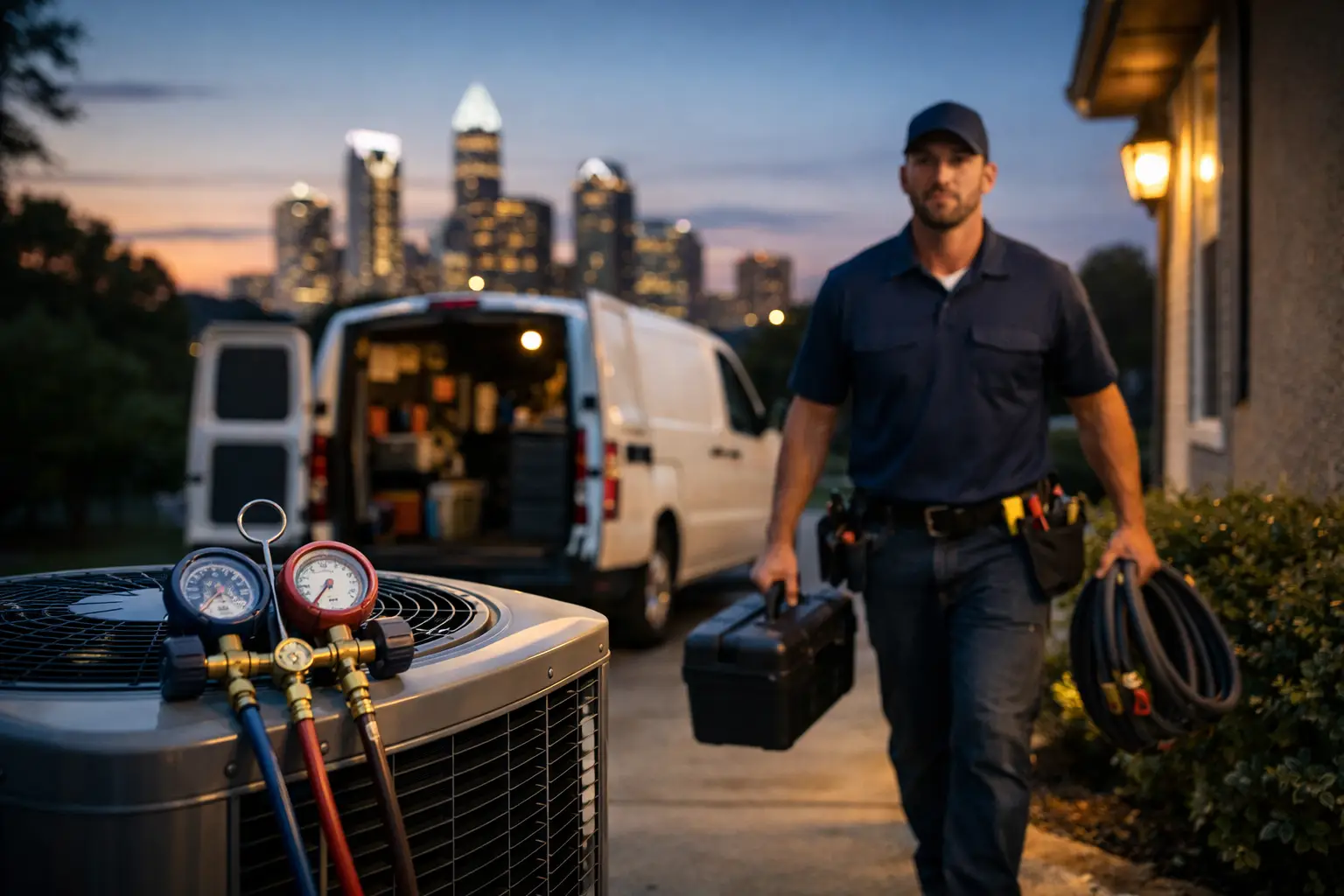
A dead AC at 9 p.m. in a Charlotte heat wave feels like an emergency. So does a furnace that quits on a freezing night, or a rooftop unit that leaves your business uncomfortable before opening. When people search for emergency HVAC repair near me, they usually need help fast – but they also need someone who will diagnose the problem honestly instead of turning a stressful call into a sales pitch.
That matters more than most people realize. Emergency service is when customers are most vulnerable to rushed decisions, vague explanations, and expensive recommendations that may not match the actual condition of the system. A real emergency HVAC company should know how to move quickly without skipping the diagnostic work that tells you whether the issue is repairable, temporary, or serious enough to justify replacement.
What actually counts as emergency HVAC repair near me?
Not every HVAC issue is a middle-of-the-night emergency, but plenty are. If your system stops cooling during extreme summer temperatures, stops heating during a cold snap, trips breakers, smells like something is burning, leaks heavily, or won’t turn on in a home with vulnerable occupants, that deserves fast attention. The same goes for commercial spaces where a system failure can affect customers, employees, inventory, or equipment.
Some issues feel urgent but can wait until normal business hours if the space is still safe. Weak airflow, uneven temperatures, strange noises without shutdown, and a thermostat that seems inaccurate may be important, but not always emergency-level. The difference usually comes down to safety, risk of further damage, and whether the building can remain reasonably livable or operational until a technician arrives.
That said, it depends on the situation. A minor cooling issue in mild weather is one thing. The same issue in a second-floor bedroom during a 97-degree day, with kids or older adults in the home, is something else entirely.
The biggest mistake people make during an HVAC emergency
The biggest mistake is assuming the first company that answers the phone will also give the best answer. In an emergency, speed matters, but diagnosis matters just as much. If a technician starts talking about replacing the entire system before testing components, checking electrical issues, or verifying refrigerant and airflow conditions, that is a red flag.
A lot of HVAC problems that seem catastrophic are not. A failed capacitor, bad contactor, clogged drain line, dirty flame sensor, blower issue, thermostat fault, or safety switch trip can shut a system down completely. To a homeowner or business owner, it looks like total failure. To a skilled technician, it may be a focused repair.
That does not mean replacement is never the right call. Sometimes an older system has multiple major failures, severe coil damage, compressor issues, unsafe furnace conditions, or repair costs that no longer make practical sense. But that conclusion should come after real testing, not before it.
What a good emergency HVAC visit should look like
A proper emergency call starts with questions, not assumptions. The technician should want to know what the system is doing, when the problem started, whether breakers have tripped, whether there are odors or leaks, and whether the unit has had recent repairs or recurring issues. That early information helps narrow down the likely causes and bring the right parts or tools when possible.
Once onsite, the process should be straightforward. The system gets inspected, electrical components are checked, airflow and control signals are evaluated, and the root cause is identified as clearly as conditions allow. If the issue can be repaired safely and reliably, you should hear that. If a temporary fix is possible but a larger repair is looming, you should hear that too. If replacement is truly the smartest option, the reasoning should be specific and easy to understand.
That kind of transparency matters because emergency calls are stressful enough. You should not have to wonder whether you are getting technical advice or a sales script.
Why emergency HVAC problems happen at the worst time
HVAC failures tend to show up when systems are under the most strain. In Charlotte-area summers, air conditioners run hard for long stretches, especially during hot, humid afternoons and evenings. In winter, heating systems often fail on the coldest nights because that is when worn parts finally give out. Emergency calls are not always caused by neglect. Sometimes a component simply reaches the end of its life under peak demand.
Still, many emergencies have warning signs. Rising energy bills, longer run times, poor airflow, odd smells, short cycling, moisture around the unit, or rooms that never quite reach the set temperature often point to a system struggling before it fails outright. People ignore those signs for understandable reasons – busy schedules, budget concerns, hoping it will make it one more season – but that gamble can turn a standard repair into an after-hours problem.
What you can check before calling
Before assuming the entire system is down, it is worth checking a few basics. Make sure the thermostat is set correctly and has power. Check the air filter if airflow seems weak. Look at the breaker panel to see whether the HVAC breaker has tripped. If you have a condensate drain safety switch, a backed-up drain can shut cooling off. For gas heat, verify the furnace switch is on.
These steps are simple, and sometimes they solve the problem. If they do not, stop there. Repeatedly resetting breakers or forcing a system to run can make the damage worse. If there is burning smell, smoke, active leaking near electrical components, or signs of overheating, shut the system down and call for service.
For homeowners, the real issue is trust
Most homeowners are not trying to become HVAC experts. They just want the house comfortable again and want to know they are not being pushed into spending thousands of dollars unnecessarily. That is why the company you call matters as much as the repair itself.
An honest technician should be able to explain the problem in plain language. Is the repair likely to restore normal operation? Is this a one-part failure or part of a bigger pattern? How old is the equipment, and what condition is the rest of it in? What would they do if it were their own house?
Those are fair questions, especially during an emergency. Good companies do not get irritated by them. They answer them clearly.
For businesses, downtime changes the equation
Commercial HVAC emergencies add another layer. A restaurant, retail space, office, church, or small warehouse cannot always wait for comfort problems to become convenient. Heat, humidity, poor ventilation, or lack of cooling can disrupt staff performance, customer experience, and in some cases equipment reliability.
That is why commercial emergency service has to be practical. The goal is not just restoring air. It is minimizing downtime, protecting the space, and helping the property operator understand whether they are dealing with a repair, a temporary workaround, or a larger planning issue. Fast service matters, but so does making the right call the first time.
Choosing emergency HVAC repair near me without getting pressured
If you are comparing companies during an emergency, look for a few signs. First, they should talk about diagnostics and repair, not just installations. Second, they should be licensed and insured. Third, they should be able to explain what they found and why they recommend a specific solution. And fourth, they should not use fear to rush you into a full replacement unless there is a legitimate safety or cost reason behind it.
That is where companies like DDL Services stand apart in the Charlotte area. The focus is on accurate diagnostics, honest repair recommendations, and fixing equipment when repair is the right solution – not treating every urgent call like an opening for a replacement sale.
Emergency HVAC service should feel urgent, but it should never feel careless. When your system fails at the worst possible time, the right response is fast, skilled, and honest. That is what turns a bad night into a manageable repair, and that is what people are really looking for when they search for help nearby.