

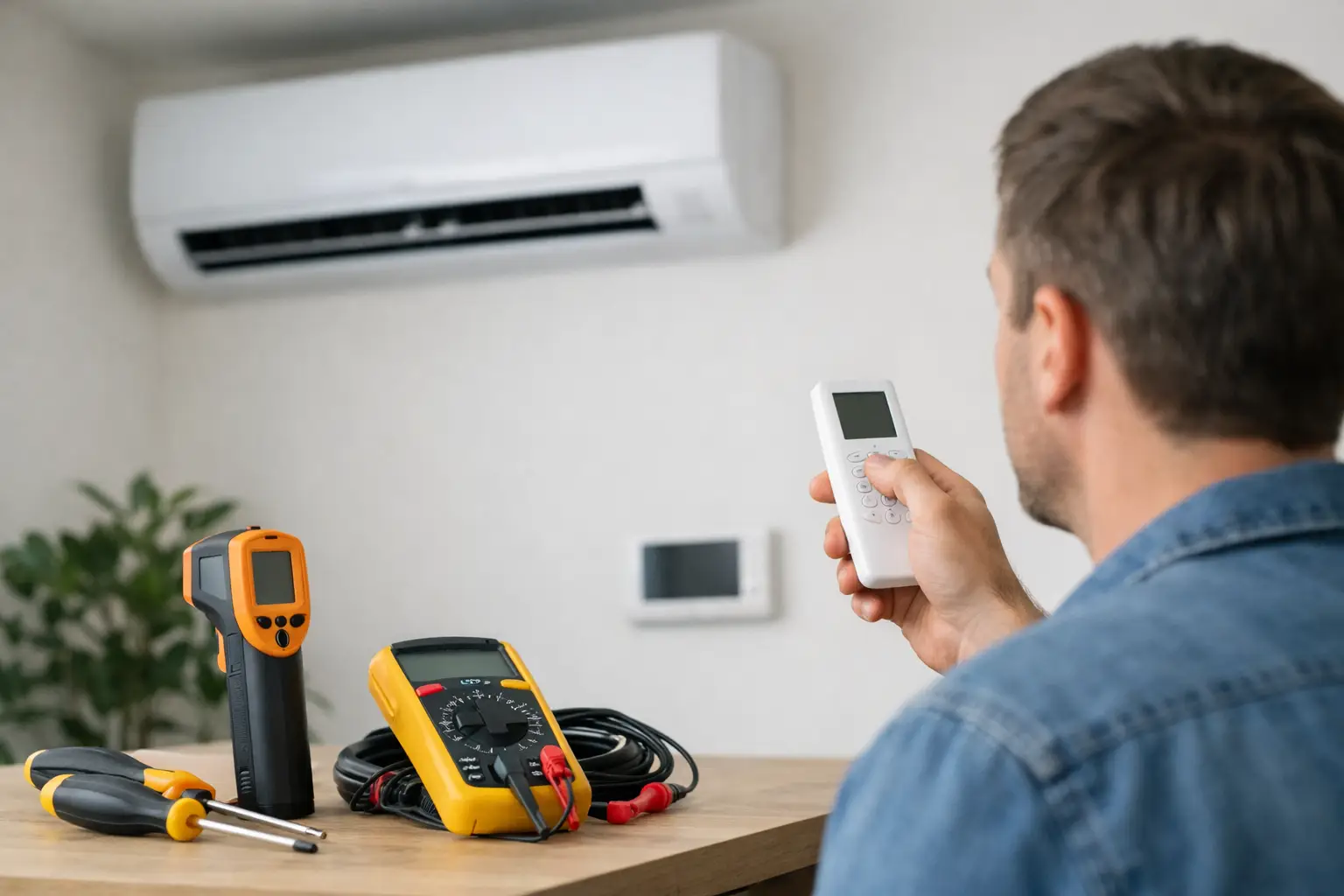
When your air conditioner is not turning on, the room gets uncomfortable fast, but that does not automatically mean you need a new system. In a lot of cases, the problem comes down to power, controls, airflow-related safety shutoffs, or a failed component that can be diagnosed and repaired without jumping straight to replacement.
That matters because this is where homeowners and property managers often get bad advice. An AC that will not start can look like a major failure from the outside, but the real issue might be as simple as a tripped breaker, a clogged drain line, or a thermostat problem. The only way to know is to check the basics first, then diagnose the equipment properly.
If your air conditioner is not turning on, check these basics first
Start with the thermostat. Make sure it is set to cool and that the temperature setting is below the current indoor temperature. If the screen is blank, change the batteries if your thermostat uses them. A dead thermostat can make it seem like the whole AC system has failed when it is really just not sending a signal.
Next, check the circuit breaker panel. Air conditioners usually have a dedicated breaker, and sometimes the indoor and outdoor units have separate power circuits. If a breaker is tripped, reset it once. If it trips again, stop there. Repeated tripping usually points to an electrical issue, and forcing it can make the problem worse.
Then look at the disconnect box near the outdoor unit if you can do so safely. Sometimes power has been shut off there during recent work or maintenance and never turned back on. Also check the furnace or air handler switch indoors. It can look like a regular light switch and may have been bumped off by accident.
These checks are simple, but they rule out a surprising number of service calls. They also help narrow down whether the issue is control-related, electrical, or happening inside the equipment itself.
Why an air conditioner will not turn on
An air conditioning system needs several things to happen in the right order before cooling starts. The thermostat has to call for cooling, the control board has to respond, safeties have to stay closed, the blower has to operate correctly, and the outdoor unit has to receive power and start. If one part of that chain fails, the system may do nothing at all.
That is why the symptom can be misleading. “Not turning on” might mean the thermostat is dead. It might mean the indoor blower runs but the outdoor unit does not. It might mean the system tries to start and shuts back down. Those are different failures, and they do not lead to the same repair.
Thermostat and low-voltage control problems
The thermostat is often the first suspect because it controls the call for cooling. Bad batteries, loose wiring, programming issues, or a failed thermostat can stop the system before it even tries to start. In some cases, a low-voltage fuse on the air handler control board blows and cuts off communication entirely.
This is one reason honest diagnostics matter. Replacing the outdoor unit will not solve a low-voltage control problem. You need someone to trace where the signal stops and why.
Drain line and float switch shutoffs
Many systems in the Charlotte area have a float switch installed on the condensate drain line or secondary drain pan. If the drain clogs and water starts backing up, that switch can shut the system down to prevent water damage.
From the homeowner’s perspective, it looks like the AC just quit. In reality, the shutdown may be doing exactly what it is supposed to do. Clearing the drain, checking for water damage, and making sure the switch is working properly is often the right repair.
Capacitor or contactor failure
If the thermostat is calling for cooling but the outdoor unit will not start, a failed capacitor or contactor is common. Capacitors help motors start and run. Contactors allow voltage to pass to the outdoor components when there is a call for cooling.
When these parts fail, the system may hum, click, or do nothing. These are repairable issues in many cases. They do not automatically mean the entire system is at the end of its life.
Blower motor and airflow-related issues
Sometimes the indoor side is the real problem. If the blower motor fails or the system detects conditions that could damage the equipment, the AC may not run normally. A severely clogged filter, frozen evaporator coil, or failed blower can affect startup and cooling operation.
This is where do-it-yourself troubleshooting has limits. Changing a dirty filter is smart. Trying to force a frozen or overheated system to keep running is not.
Electrical or safety control problems
Loose wiring, failed relays, bad sequencers, damaged boards, pressure switches, and other electrical issues can all keep an AC from turning on. In commercial settings, the control sequence can be even more involved, especially with package units or zoning systems.
These are not guesswork repairs. If someone starts swapping major parts without proving the failure, you can spend a lot of money and still have the same problem.
What you can safely do before calling for service
There are a few practical steps that make sense before you schedule a repair. Check the thermostat settings, replace the batteries if needed, verify the breakers are on, and make sure the air filter is not packed with dust. If your system has a visible drain line issue and you know how to safely clear minor buildup, that may restore operation.
After that, it is best to stop and let a technician test the system properly. If the breaker keeps tripping, if you smell burning, if the outdoor unit buzzes and will not start, or if the system starts then quickly shuts off, those are not situations to keep experimenting with. The right next step is diagnosis, not trial and error.
When repair makes sense and when replacement might
A lot of customers worry that calling for service on an AC that will not turn on means they are about to get sold a whole new system. That should not be the default answer.
If the problem is a capacitor, contactor, drain safety switch, thermostat issue, wiring fault, or another isolated component failure, repair is often the sensible move. Even on older systems, a targeted repair can still be the right call if the equipment is otherwise in decent shape and the cost makes sense.
Replacement enters the conversation when the diagnosis points to multiple major failures, severe coil damage, compressor failure with poor overall system condition, or a unit that has become unreliable and expensive to keep alive. Age matters, but age alone should not make the decision. Condition, repair history, efficiency, refrigerant type, and total cost all matter too.
That is the difference between service-led HVAC work and sales-led HVAC work. One starts with what failed. The other starts with what it can sell.
Why accurate diagnostics matter for homes and businesses
For homeowners, a bad diagnosis usually means wasted money and more time in a hot house. For businesses, it can also mean unhappy customers, distracted employees, and lost productivity. Either way, the cost of guessing adds up fast.
A proper diagnostic visit should answer a few basic questions clearly. Is the system getting power? Is it receiving a cooling call? Which component is failing to respond? Is there a safety shutting the system down for a reason? Is the repair likely to solve the issue reliably, or is this part of a bigger pattern?
Those answers give you something better than a sales pitch. They give you a real basis for deciding what to do next.
If your air conditioner is not turning on in Charlotte
Hot Carolina weather does not give you much room to wait around, especially during a stretch of high heat and humidity. If your system will not start, quick response matters, but so does getting the diagnosis right the first time.
DDL Services works with homeowners and commercial clients who want the actual problem identified and fixed, not pushed toward replacement before the equipment has even been properly checked. Sometimes the solution is simple. Sometimes it is more involved. Either way, the right approach is the same: test the system, explain what failed, and recommend the repair or replacement that honestly fits the condition of the equipment.
If your air conditioner is not turning on, start with the basics, then trust the diagnosis more than the sales script. A lot of cooling problems look worse than they are until someone actually finds the cause.