

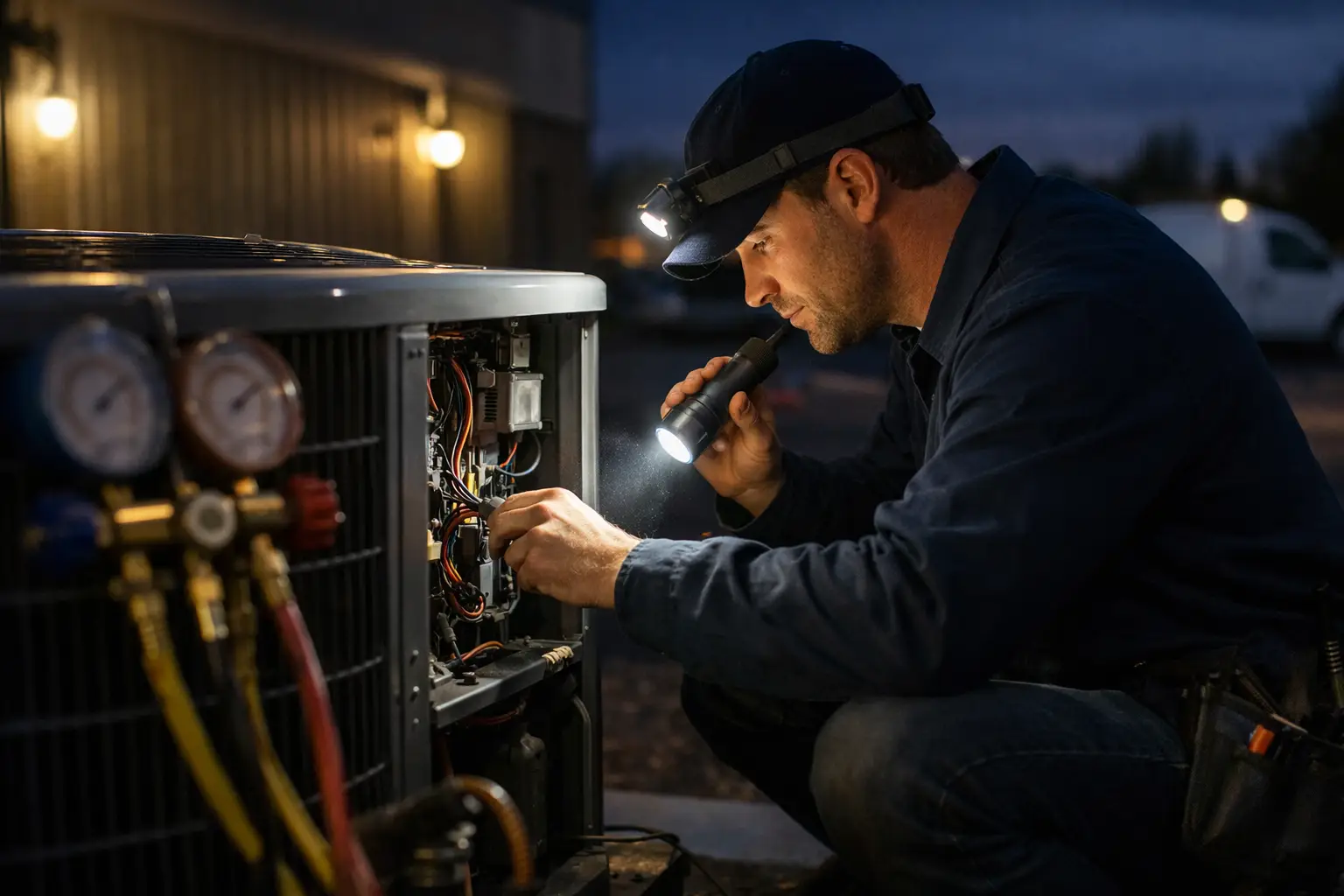
A Charlotte homeowner notices the thermostat reading 78 degrees at 10:30 p.m. The outdoor AC unit is running, but the vents are blowing warm air and the house is getting hotter by the minute. This after hours hvac repair example shows what a good emergency service call should look like: calm communication, a real diagnosis, and a repair recommendation based on the problem – not a rushed pitch for new equipment.
An HVAC issue outside normal business hours can feel like an emergency long before it becomes one. For a family with young children, an older adult, pets, or a health concern, losing cooling during a humid North Carolina night is more than an inconvenience. The same is true for a small business with temperature-sensitive inventory, tenants, or customers arriving the next morning.
The goal of after-hours service is not to create panic. It is to determine what failed, protect the equipment from further damage, restore safe operation when possible, and explain the next step clearly.
After Hours HVAC Repair Example From Call to Fix
In this situation, the homeowner calls because the system has been cooling poorly all evening and has now stopped keeping up entirely. Before dispatching a technician, a professional office should ask useful questions: Is the thermostat set to cool? Is the indoor blower running? Has a breaker tripped? Is there water around the indoor unit? Is there a burning smell, smoke, or a carbon monoxide alarm?
Those questions are not meant to make the customer diagnose the system. They help identify immediate safety concerns and give the technician a better starting point. If there is smoke, a burning odor, sparking, or a suspected gas leak, the system should be turned off and the proper emergency authority should be contacted when needed. An HVAC repair should never take priority over safety.
When the technician arrives, the first step is verification. The thermostat may be calling for cooling, but that does not tell anyone why the home is warm. A technician checks the electrical supply, indoor and outdoor equipment operation, airflow, refrigerant circuit conditions, condensate drainage, and safety controls. The right repair begins with evidence.
In this example, the outdoor condenser is receiving power, but the contactor is badly worn and intermittently failing to send voltage to the compressor and fan motor. The capacitor is also testing below its rated range. Either part can cause starting problems. Together, they explain why the unit ran inconsistently before it stopped cooling.
The technician explains the findings in plain language. The contactor and capacitor are serviceable repair items, and replacing them is appropriate if the rest of the system is operating properly. There is no reason to recommend a new air conditioner simply because the repair happened at night.
After approval, the technician replaces the failed components, checks wire connections, restarts the system, and verifies that the compressor and fan are operating correctly. Then comes the part customers should expect but do not always receive: confirmation that the system is actually cooling. Supply-air temperature, operating pressures, electrical readings, and drain function should all be checked before the call is closed.
The home may not reach the thermostat setting instantly, especially after several hours of heat buildup. But cool air should be returning, the equipment should be operating within normal ranges, and the homeowner should know what was repaired and what to watch for overnight.
What Makes an HVAC Issue Worth an After-Hours Call?
Not every HVAC problem requires an emergency visit. A system that is slightly less efficient than usual can often wait until the next business day, particularly when the home remains safe and reasonably comfortable. Calling during normal hours may be the more economical choice for a minor issue.
But some problems should not wait. Complete loss of air conditioning during extreme heat, no heat during freezing weather, water leaking heavily from an air handler, electrical burning smells, repeated breaker trips, and a commercial system failure affecting operations are all valid reasons to seek urgent help. The same applies when vulnerable people are in the building and indoor conditions are becoming unsafe.
A furnace problem requires extra caution. If a carbon monoxide alarm sounds, leave the building and contact emergency services or the gas utility according to their instructions. Do not reset the alarm, relight equipment, or wait for an HVAC appointment before taking safety action.
For a cooling problem without immediate danger, there are a few reasonable checks a homeowner can make before calling. Confirm the thermostat has fresh batteries if applicable and is set to cool. Check that the return-air filter is not severely clogged. Look for a tripped breaker, but do not repeatedly reset one that trips again. If the indoor coil may be frozen, turn the cooling mode off and leave the fan set to on to allow thawing. Do not chip ice off the coil or keep forcing the system to run.
These steps can prevent unnecessary damage, but they are not a substitute for diagnosis. A frozen coil, for example, may be caused by restricted airflow, low refrigerant from a leak, a blower problem, or a control issue. Adding refrigerant without finding a leak is not a complete repair.
Honest Diagnosis Matters More After Dark
After-hours calls come with pressure. The customer is uncomfortable, the equipment is down, and nobody wants a long conversation at midnight. That is exactly why clear diagnosis matters.
A trustworthy technician should be able to explain what failed, how that failure was verified, whether the repair is temporary or durable, and what the cost includes. If replacement is discussed, there should be a technical reason behind it. A cracked heat exchanger, an obsolete part that cannot be sourced, repeated major failures, or a severely deteriorated system may justify that conversation. A failed capacitor alone usually does not.
There are trade-offs. Repairing an older unit can make sense when the repair is modest and the system has otherwise been dependable. Replacement may make more financial sense when repair costs are high, efficiency is poor, refrigerant availability is a concern, or multiple major components are failing. The decision depends on the actual condition of the equipment, not the time on the clock.
For commercial customers, the same principle applies with another factor: downtime. A restaurant, office, retail space, or rental property may need a safe temporary solution overnight and a more involved repair the next day. A good contractor separates what must be done now from what can be planned properly, so the customer is not pushed into a costly decision under pressure.
Questions to Ask During an Emergency HVAC Visit
You do not need to know HVAC terminology to protect yourself. Ask the technician what they found, what test confirmed it, and whether the repair will restore normal operation or only stabilize the system. Ask whether there are other conditions that should be addressed soon, and request that the recommendations be prioritized.
It is also fair to ask about pricing before work begins. Emergency service often carries different rates because technicians are responding outside standard hours. That does not excuse vague pricing or surprise charges. You should understand the diagnostic charge, repair cost, and any available options before authorizing work.
Written documentation helps as well. It gives homeowners a record of the failed part and gives facility managers useful information for maintenance planning. If a recurring issue is found, such as clogged drains, neglected filters, or electrical wear, that record can help prevent another after-hours failure.
What Happens After the Emergency Repair
A successful late-night repair does not always mean the system needs nothing else. In the example above, the technician may recommend a daytime maintenance visit if the unit is overdue for service. That visit can include cleaning, checking refrigerant performance, inspecting electrical components, clearing the condensate drain, and reviewing overall equipment condition.
This is not a sales pitch. It is a practical way to catch the smaller issues that often lead to a breakdown at the worst possible time. Preventive maintenance cannot stop every failure, but it can identify weak capacitors, worn contactors, dirty coils, drainage problems, and airflow restrictions before they leave a home or business without comfort.
When an HVAC system quits after hours, look for a contractor who treats the call like a technical problem to solve. DDL Services focuses on finding the real cause, explaining the repair clearly, and recommending replacement only when the equipment condition truly supports it. A calm, competent repair tonight can give you the time and information to make the right decision tomorrow.