

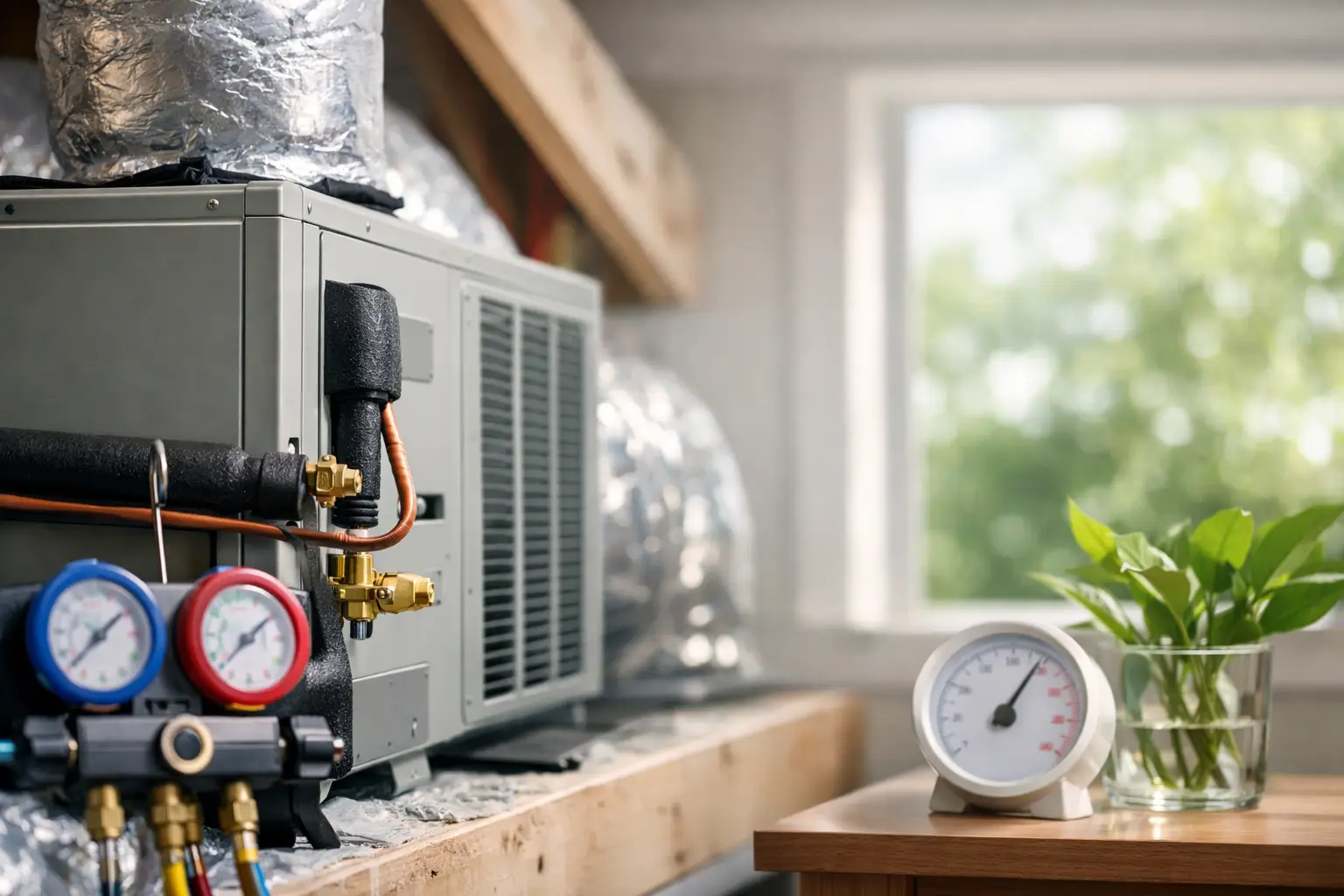
If your home feels cool but still clammy, the thermostat is only telling part of the story. We see this often when homeowners say proper system sizing lowered humidity in one house but not in another, and the difference usually comes down to how the equipment was matched to the space, not just how cold the air feels coming out of the vents.
That matters in North Carolina. In Charlotte and the surrounding area, summer humidity is not a small side issue. It changes how a house feels, how hard your AC has to work, and whether your indoor air actually feels comfortable. A system can hit the set temperature and still leave you with damp air, musty smells, and that sticky feeling that makes people keep lowering the thermostat for relief.
Why proper system sizing lowered humidity in some homes
Air conditioners do two jobs at the same time. They lower temperature, and they remove moisture from the air. A lot of people only focus on the temperature side because that is what they can see on the thermostat. Humidity control happens more quietly, but it is just as important.
For an AC system to remove moisture well, it needs enough runtime. When warm indoor air passes over a cold evaporator coil, water vapor condenses and drains away. That process works best when the system runs long enough to keep pulling moisture out. If the unit is too large for the home, it cools the space too quickly and shuts off before it has done much dehumidifying.
That is the part many sales conversations skip. Bigger is not automatically better. An oversized system can satisfy the thermostat fast, short cycle all day, and leave the house feeling cold and damp at the same time. Homeowners often describe it as uncomfortable, muggy, or just never quite right.
A properly sized system runs in a more controlled way. It does not have to sprint to the finish every cycle. It has enough capacity to cool the home, but it also stays on long enough to remove moisture consistently. That is why proper system sizing lowered humidity in many homes where the old unit was oversized.
The oversized AC problem nobody wants to pay for twice
Oversizing usually happens for predictable reasons. Sometimes a contractor guesses instead of calculating the load. Sometimes they replace old equipment with the same tonnage without looking at insulation, windows, duct leakage, or home updates. Sometimes people ask for a larger unit because they assume it will cool faster and solve every comfort issue.
It may cool faster. That is the problem.
Short cycling creates several issues at once. First, humidity stays high because the coil does not stay cold long enough to remove as much moisture as it should. Second, frequent starts and stops add wear to components. Third, rooms can end up with uneven temperatures because the air distribution never settles into a steady cycle. And finally, utility bills can climb even though comfort drops.
This is where honest diagnosis matters. If a house feels humid, the answer is not always a replacement. It is not always a bigger unit either. Sometimes the issue is poor airflow, a dirty coil, low refrigerant, a fan speed problem, leaky ducts, or a drain issue affecting performance. But when replacement really is needed, sizing has to be done correctly or the same comfort problem comes right back.
What proper sizing actually means
Proper sizing is not a guess based on square footage alone. Square footage is part of the picture, but it is not enough by itself.
A real sizing process looks at how the building gains heat and holds moisture. That includes insulation levels, window size and direction, air leakage, ceiling height, duct condition, occupancy, and even how much sun hits different parts of the property. In commercial settings, internal loads from lighting, equipment, and people also matter.
Two homes with the same square footage can need very different systems. One may have newer windows, better attic insulation, and tighter ductwork. The other may leak air badly and have hot spots in afternoon sun. Giving both buildings the same size unit because they “look similar” is how comfort problems start.
Proper sizing also includes matching system components correctly. The outdoor unit, indoor coil, blower, and duct system all affect performance. If those pieces are mismatched, humidity control can suffer even if the tonnage seems close on paper.
Signs your system may be the wrong size for humidity control
You do not need instruments to notice when something feels off. A house with poor humidity control usually gives clear signals.
If indoor air feels sticky even while the AC runs, that is a red flag. If the thermostat reaches the target temperature quickly but comfort still feels poor, that matters too. You may also notice musty odors, condensation on vents or windows, uneven cooling, or a system that turns on and off constantly.
In some homes, people keep dropping the thermostat lower and lower just to feel dry. That often leads to overcooling without solving the real issue. The air gets colder, but not necessarily less humid.
For business owners, the warning signs can show up as uncomfortable offices, moisture-related odor complaints, or uneven comfort between zones. Commercial properties with frequent door openings or varying occupancy can be especially sensitive to equipment and airflow issues.
When sizing is not the only issue
It would be easy to say every humidity complaint is caused by an oversized system, but that would not be honest. Humidity problems can come from several sources, and sometimes more than one is happening at once.
Leaky return ducts can pull humid air from attics or crawl spaces. Poor blower settings can move air too fast across the coil, reducing moisture removal. A dirty evaporator coil can limit heat transfer. Low refrigerant can hurt system performance. In some homes, outside air infiltration is simply too high because the structure is not sealed well.
That is why a technician-led approach matters. If someone jumps straight to replacement without checking the basics, you may spend a lot of money and still have the same indoor comfort problem. The better path is to diagnose first, then recommend the fix that matches the actual cause.
Why variable-speed equipment can help, but only when matched correctly
You may hear that variable-speed systems are better for humidity control, and in many cases that is true. They can run longer at lower capacity, which helps remove moisture more steadily. That can make indoor comfort much more consistent during humid weather.
But even better equipment does not erase bad sizing. A high-end system that is too large for the home can still create comfort issues. Features help, but proper application matters more than sales language.
The same goes for dehumidifiers. A whole-home dehumidifier can be a smart solution in some houses, especially if the building has persistent moisture load from infiltration, crawl space issues, or lifestyle factors. Still, it should support a well-performing HVAC system, not cover up a sizing or airflow problem that was never addressed.
What homeowners and property managers should ask
If you are replacing a system because of humidity complaints, ask how the new size is being determined. Ask whether the ductwork has been evaluated. Ask if airflow, coil match, and fan settings are part of the recommendation. Those are practical questions, not difficult ones.
If the answer sounds like a quick guess, or if the only sales pitch is that a larger unit will cool faster, be careful. Fast cooling and good comfort are not the same thing.
A trustworthy contractor should be able to explain why a certain system size makes sense for your building and how that choice affects both temperature and moisture control. That is especially important if your current system already struggles with indoor humidity.
At DDL Services, that is the difference in approach. The goal is to find the real problem and fix it, not push equipment that sounds impressive but is wrong for the space.
Proper system sizing lowered humidity by improving runtime
At the technical level, most humidity improvements come back to one thing: better runtime. A correctly sized system runs long enough to let the coil condense and remove moisture steadily. It avoids the fast on-off pattern that leaves air cool but damp.
That longer, steadier operation can also reduce temperature swings, improve airflow balance, and make the whole building feel more stable. People often notice they are more comfortable at a slightly higher thermostat setting once humidity is under control. That can lower strain on the system and reduce energy waste at the same time.
The trade-off is that proper sizing does not always feel dramatic in the way oversized equipment does. It may not blast the house with a sudden rush of cold air and shut off in minutes. Instead, it works the way it should – consistently, quietly, and with better moisture removal. In real life, that is usually the better result.
If your AC cools the house but never really makes it feel dry, do not assume you need the biggest system on the market. The better answer is usually more careful than that. Comfort comes from matching the equipment to the building, checking the full system, and solving the humidity problem at its source.