

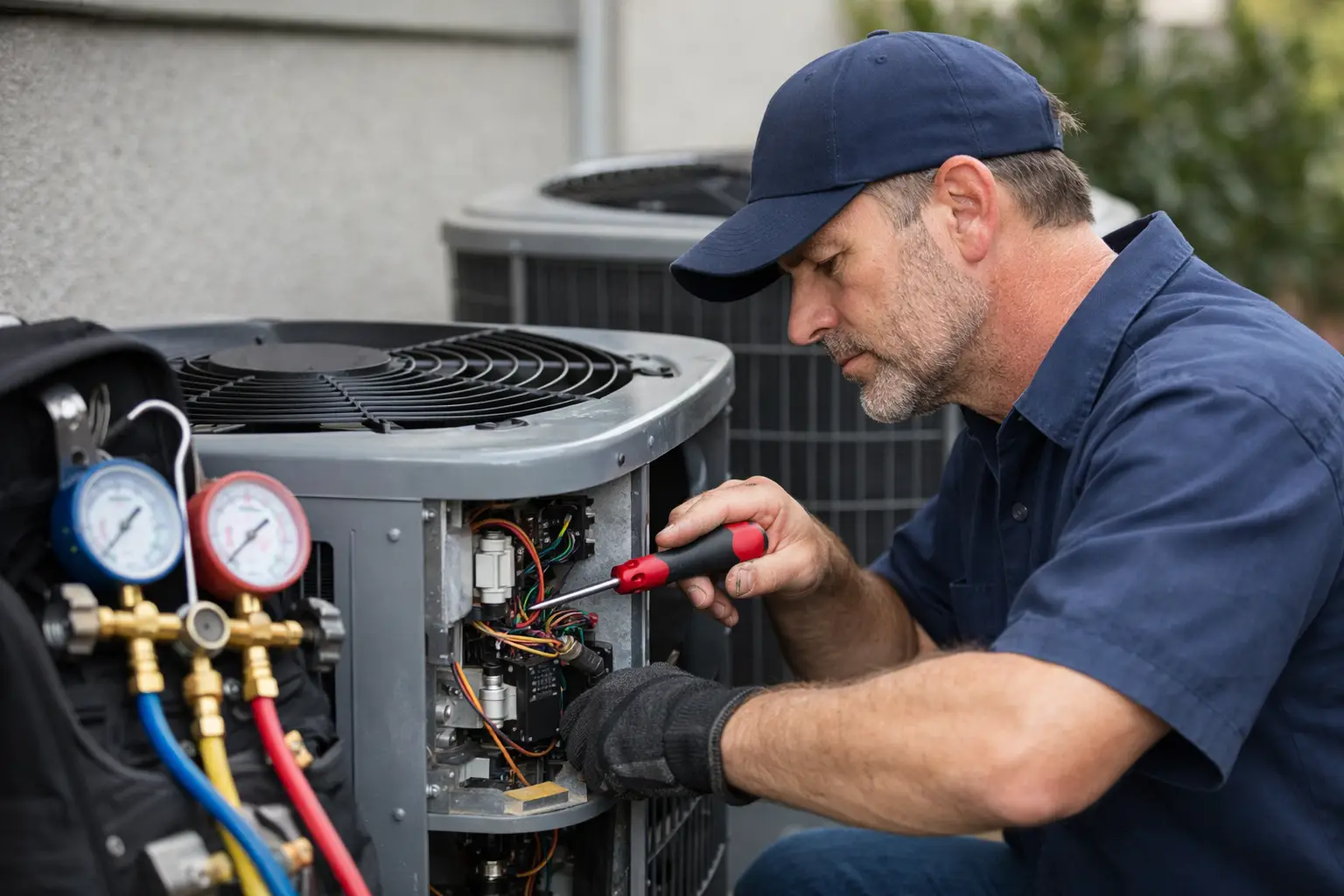
When an older AC or furnace starts acting up, a lot of homeowners hear the same line almost immediately: it’s old, so it needs to be replaced. Sometimes that is true. A lot of the time, it is not. Repairing older HVAC systems can still be the smartest move when the problem is specific, the equipment is fundamentally sound, and the diagnosis is based on facts instead of a sales target.
That matters in Charlotte-area homes and commercial buildings where summer heat, humidity, and winter cold all put real strain on equipment. Age does increase risk, but age by itself does not tell you what is broken, how serious it is, or whether a practical repair can give you several more reliable years.
Repairing Older HVAC Systems Starts With Diagnosis
The first question should never be, “How old is it?” The first question should be, “What is it actually doing, and why?” An older system can stop cooling for reasons that range from a bad capacitor to a failing compressor. Those are not the same repair, and they definitely do not justify the same recommendation.
A proper diagnosis looks at operation, airflow, electrical components, refrigerant performance, temperature split, control signals, and overall equipment condition. On the heating side, it may also include burners, heat exchangers, ignition components, safeties, and venting. On commercial equipment, control issues, blower performance, and staged operation often matter just as much as the age of the unit.
This is where honest service makes a real difference. If the actual problem is a contactor, blower motor, condensate safety switch, or failed thermostat, replacing the entire system would be hard to justify. If the equipment has multiple major failures, chronic leaks, unsafe operation, or severely declining efficiency, that is a different conversation.
What Usually Fails First in Older HVAC Equipment
Most older systems do not fail all at once. They wear out in pieces. That is why a blanket statement about replacement rarely makes sense.
Capacitors, contactors, fan motors, blower motors, relays, igniters, flame sensors, and control boards are common repair items as systems age. Drain line issues, dirty evaporator coils, weak airflow, duct leaks, and failing thermostats also create problems that can look more dramatic than they are. In air conditioning systems, refrigerant leaks and compressor issues tend to be the bigger turning points because they affect both repair cost and long-term reliability.
In gas furnaces, the most serious concern is safety. A cracked heat exchanger, combustion problem, or venting issue should never be minimized. In those situations, the right decision is based on safe operation first, cost second.
Older systems also tend to develop layered problems. A unit may have weak airflow from a dirty coil, short cycling from a control issue, and poor cooling from low refrigerant charge. If one symptom gets all the attention, the real cause gets missed. That is how people end up paying for repeat service calls without solving the underlying issue.
When Repair Makes Sense
Repair is usually the right call when the system has a clear, isolated problem and the rest of the equipment is in reasonable condition. If the compressor is healthy, the heat exchanger is sound, the cabinet is intact, and the system has not become a cycle of constant breakdowns, a targeted repair can be a solid investment.
It also makes sense when the repair cost is proportionate to the remaining life of the equipment. An older system does not have to be perfect to be worth fixing. It just has to be capable of operating safely and dependably after the repair.
For many homeowners and small business owners, budget timing matters too. A repair may be the best practical decision if it restores performance now and gives you time to plan a replacement on your terms instead of during an emergency in July or January. There is nothing wrong with making a measured decision as long as you understand the condition of the system and the likely risks ahead.
When Repairing Older HVAC Systems Stops Being Practical
There is a point where repair becomes a temporary patch on a system that is already at the end of its useful life. The key is being honest about where that line is.
If the equipment has a major compressor failure, a cracked heat exchanger, an obsolete refrigerant issue, or repeated high-cost repairs stacked on top of each other, replacement may be the more responsible recommendation. The same applies when parts availability becomes a problem or when the system is oversized, undersized, or badly mismatched and has never performed correctly to begin with.
Efficiency also matters, but it should not be oversold. A new system can reduce operating costs, but energy savings alone do not justify every replacement. The numbers need to make sense. If an older unit needs a moderate repair and can still run dependably, that may be better than forcing a rushed full-system investment.
The right answer is not repair at all costs. It is repair when repair is reasonable, and replacement when replacement is truly the better long-term move.
The Real Cost of Guesswork
One of the biggest problems with older HVAC equipment is not the equipment itself. It is bad diagnosis. When a contractor guesses, changes parts without testing, or recommends replacement before checking fundamentals, the customer pays for it.
A frozen coil might be blamed on low refrigerant when the real issue is airflow. A furnace lockout might get pinned on age when the root cause is a pressure switch problem, vent restriction, or dirty flame sensor. A noisy unit might be sold as “worn out” when a motor mount or blower wheel is the real issue.
Accurate diagnosis protects your money. It also protects uptime. For a business, unnecessary replacement recommendations can disrupt operations, scheduling, and budgeting. For a homeowner, they create stress at the exact moment you need clear answers.
That technician-led, problem-first approach is why companies like DDL Services put so much emphasis on finding the actual failure before talking about major replacement options.
How to Judge an Older System Honestly
The best repair decisions come from looking at the full picture, not just the model number. A good evaluation includes the age of the equipment, yes, but also repair history, operating performance, safety condition, refrigerant type, efficiency, part availability, and how well the system has been maintained.
Maintenance history matters more than many people realize. A 16-year-old system that has had regular service and clean airflow may be in better shape than a 10-year-old system that has been neglected. Indoor coil condition, duct performance, static pressure, and electrical wear all tell a more useful story than age alone.
Usage pattern matters too. A system serving a busy retail space or a home with zoning challenges may wear differently than one in a lightly used office or a well-insulated house. That is why honest recommendations should be specific to the property, not copied from a script.
Repair vs. Replacement Is Not a Sales Script
Customers usually do not need pressure. They need a straight answer. If a repair is reasonable, it should be presented that way. If replacement is the better path, the explanation should be clear and technical, not dramatic.
That means showing what failed, explaining what else looks worn, and being upfront about the likely remaining life after repair. It also means acknowledging uncertainty. No technician can promise that a 15- or 20-year-old unit will never have another issue. What they can do is tell you whether the current repair is likely to restore reliable operation and whether the system is worth investing in any further.
That kind of transparency is especially important for older HVAC equipment because the stakes are higher. A wrong call can cost thousands. A rushed replacement can be just as frustrating as repeated repairs if the new equipment is not properly matched to the building.
What Property Owners Should Do Next
If your older system is struggling, do not start with the assumption that replacement is inevitable. Start with a real evaluation. Ask what failed, what was tested, whether the issue is isolated or part of a bigger pattern, and what the likely next steps look like if you repair it.
You should also ask whether the system is operating safely, whether parts are still reasonably available, and whether the repair restores normal function or only buys a short window. Those answers matter more than a generic opinion about age.
Repairing older HVAC systems is not about trying to keep every old unit alive forever. It is about making a sound decision based on condition, safety, performance, and cost. If the system can be fixed properly, that is often the right move. If it cannot, you deserve a clear reason why.
A good HVAC contractor should make that decision easier, not more expensive or more confusing.