

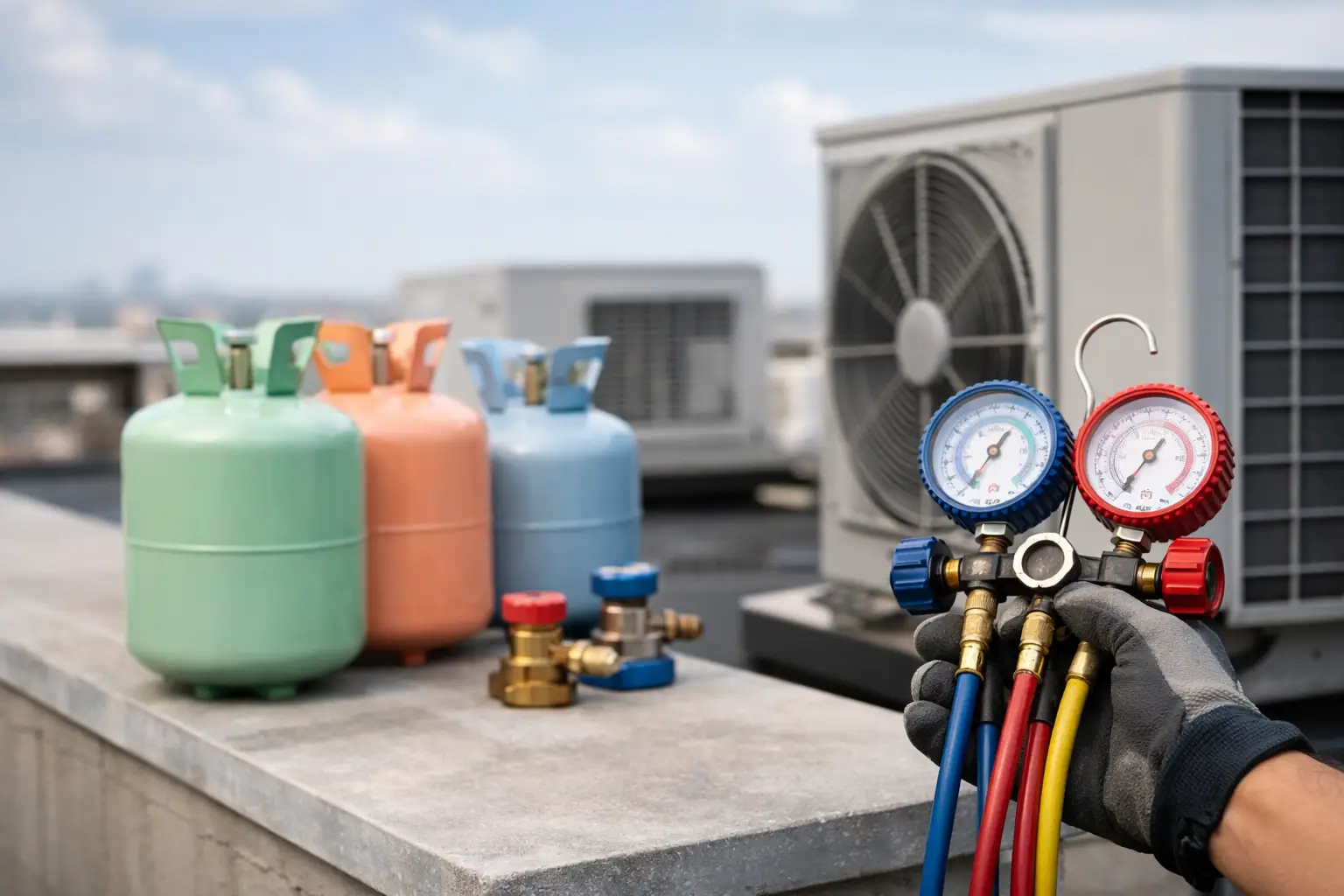
If you have been told your AC uses an “old refrigerant” and that means you need a full system replacement, stop there. HVAC refrigerant changes explained in plain English usually sound a lot less dramatic than some sales pitches make them seem. The refrigerant rules are changing, yes, but that does not automatically mean your equipment is unsafe, illegal, or beyond repair.
Most homeowners and property managers do not need a chemistry lesson. They need straight answers. What changed, what it means for their current system, and whether a repair still makes sense. That is where a lot of the confusion starts, because refrigerant transitions get mixed together with equipment age, repair costs, efficiency upgrades, and sales pressure.
HVAC refrigerant changes explained for real-world decisions
There have been a few major refrigerant shifts in HVAC over the years. Older systems commonly used R-22, which was phased out because of its impact on the ozone layer. Newer residential systems have mostly used R-410A for years. Now the industry is moving again, this time toward refrigerants with lower global warming potential, often called low-GWP refrigerants.
That sounds simple enough until you are standing next to an outdoor unit that is not cooling and someone tells you parts are hard to get, refrigerant is changing, and replacement is your only option. Sometimes replacement is the right call. Sometimes it is not. The refrigerant change itself is only one part of that decision.
The current transition is mostly about reducing environmental impact. It is not a sudden ban on every existing system. If your system uses R-410A, that does not mean it became obsolete overnight. It means manufacturers are moving toward newer refrigerants in newly built equipment.
What refrigerants are changing right now?
For many property owners, there are really three categories that matter.
R-22 is the old one. It has been phased out from production and import for new supply, which means it is expensive and limited. If your system still uses R-22 and has a major leak, repair can become costly fast.
R-410A has been the standard in many air conditioners and heat pumps for years. It does not damage the ozone layer the way R-22 does, but it has a higher global warming potential than the refrigerants replacing it in newer equipment.
Newer refrigerants, including options such as R-454B and R-32 in some equipment, are being adopted in new systems because they lower environmental impact. These refrigerants are part of the next generation of HVAC design, but they also require equipment specifically built for them.
That last part matters. Refrigerants are not plug-and-play. You generally cannot take an older system designed for one refrigerant and simply fill it with a different one because the industry changed directions.
Why this does not mean every older system needs to go
This is where honest service matters. A refrigerant transition affects new equipment manufacturing first. It does not mean technicians must rip out every older unit in Charlotte, Monroe, Matthews, Indian Trail, or anywhere else tomorrow morning.
If your current system is cooling properly, has no major leak, and is in otherwise repairable condition, you may have time on your side. A well-diagnosed repair can still be the smart move, especially if the issue is electrical, airflow-related, or component-based rather than a catastrophic refrigerant leak.
The real question is not, “Is my refrigerant old?” The real question is, “What failed, what will it cost to fix, and how much life is realistically left in this system?”
Those are different questions, and they deserve different answers.
Repair vs. replacement depends on the actual problem
A system with a bad capacitor, failing contactor, clogged coil, blower issue, or thermostat problem does not need to be replaced because refrigerant regulations changed. It needs the correct repair.
On the other hand, if you have an older R-22 unit with a leaking evaporator coil or condenser coil, the math may look very different. Between leak repair, refrigerant cost, and system age, replacement may be more practical. Not because someone wants to sell a new unit, but because the repair may not give you a good return.
R-410A systems sit in the middle for many customers right now. These systems are still common, parts are still serviceable in many cases, and repairs often make sense. The fact that future equipment is moving to a different refrigerant does not erase the value of a solid repair on an otherwise healthy R-410A system.
That is why blanket advice is a problem. Two systems can be the same age, but one may need a straightforward repair and the other may be near the end of its useful life.
HVAC refrigerant changes explained without the scare tactics
Some of the fear around refrigerant changes comes from half-true statements. Yes, older refrigerants can be more expensive. Yes, future equipment standards are changing. Yes, some refrigerant types are being phased down in favor of newer options.
But no, that does not mean every service call should end with a replacement quote.
A good technician should be able to tell you whether your system has a leak, whether that leak is repairable, whether the refrigerant is still available, and whether the repair cost makes sense compared to the age and condition of the equipment. That is a diagnosis, not a sales script.
If someone jumps straight from “refrigerant changes are coming” to “you need a whole new system today,” ask more questions.
What to expect if you do need a new system
If replacement is the right move, refrigerant changes are not something to fear. Newer systems are being designed around the latest standards, and that is normal in HVAC. The bigger issue is making sure the new equipment is matched correctly to the building, installed properly, and commissioned by people who know what they are doing.
This is especially important with newer refrigerants because system design, charge accuracy, airflow, and safety requirements all matter. A poorly installed high-efficiency unit can underperform just as badly as an older one.
For homeowners, that means the best replacement is not always the biggest or most expensive option. For commercial clients, it means downtime, load demands, duct conditions, controls, and long-term serviceability should all be part of the conversation.
The refrigerant itself matters, but the quality of the installation matters more in day-to-day performance.
What homeowners and property managers should do now
If your system is working, keep up with maintenance and do not make a panic decision. Clean filters, regular inspections, coil condition, drain performance, and refrigerant charge all affect how long your equipment lasts.
If your system is not working, ask for a real diagnosis before discussing replacement. You want to know whether the problem is a leak, a failed component, poor airflow, a dirty coil, or a control issue. Those details matter.
If your unit uses R-22, be especially cautious about repeated refrigerant top-offs. Refrigerant does not get “used up” like gas in a car. If it is low, there is a leak. At that point, the smart move depends on leak location, repair cost, and system age.
If your unit uses R-410A, do not assume it is suddenly unserviceable. Many of these systems can still be repaired responsibly when the failure is isolated and the equipment is otherwise in decent shape.
And if you are planning ahead for replacement in the next few years, this is a good time to start budgeting and asking informed questions. That gives you more control and less chance of making a rushed decision during a no-cooling emergency in the middle of summer.
At DDL Services, the goal is simple: find the real problem and give customers a straight answer about whether repair or replacement actually makes sense. That approach matters even more during refrigerant transitions, because confusion creates openings for bad advice.
Refrigerant rules will keep evolving. What should not change is the standard for honest HVAC service. If the explanation is clear, the diagnosis is specific, and the recommendation matches the actual condition of the system, you are probably on the right track.