

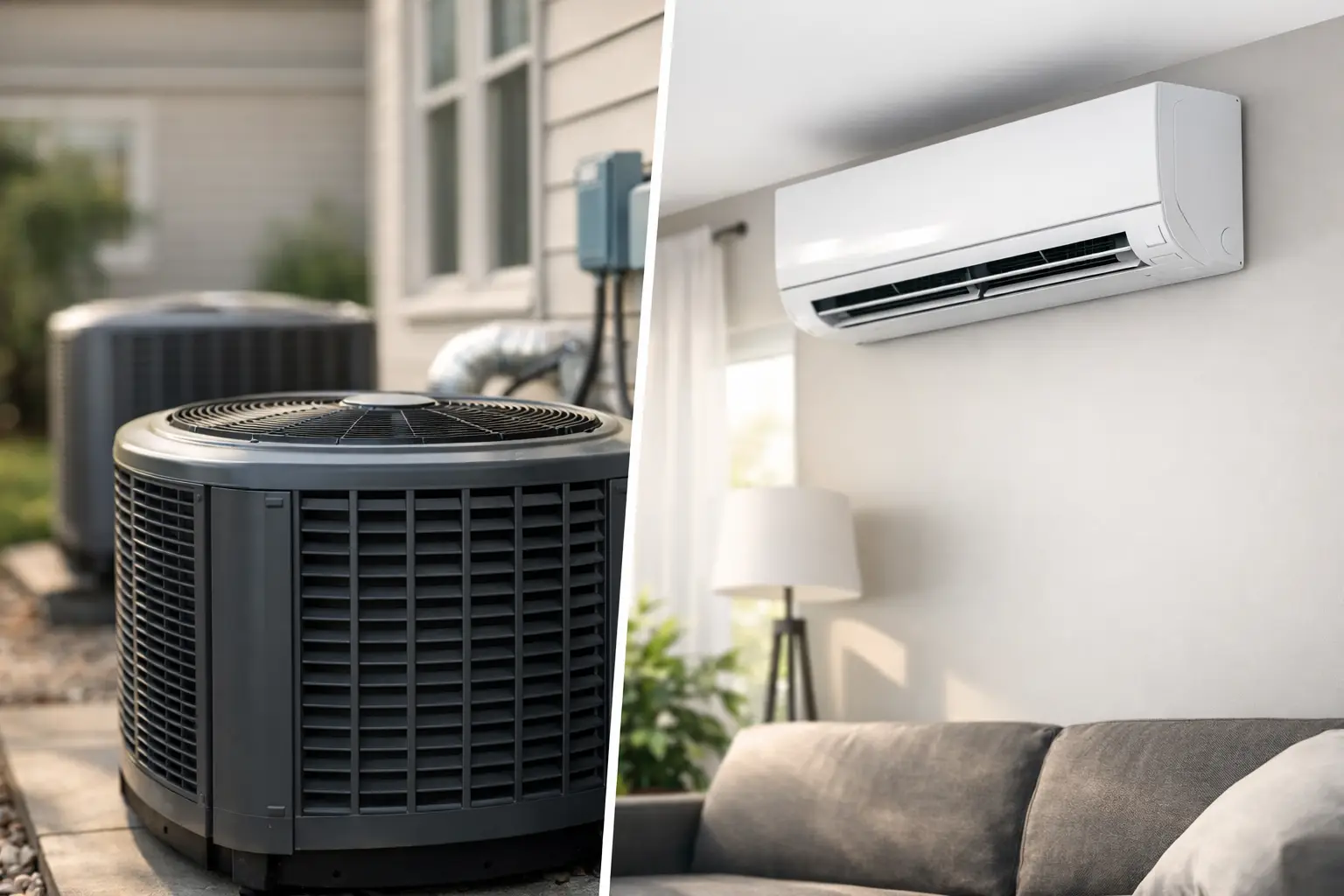
If your AC is struggling, the question usually shows up fast: should you repair what you have, install central air, or switch to a ductless system? When homeowners compare central air versus mini split, the right answer depends less on hype and more on how the building is laid out, what shape the ductwork is in, and how you actually use each room.
That matters in Charlotte-area homes and small commercial spaces because one-size-fits-all recommendations usually lead to wasted money. A house with solid ductwork and even cooling needs is a very different situation than an older home with hot upstairs bedrooms, a finished garage, or an addition that never cooled correctly.
Central air versus mini split: the real difference
Central air cools the whole home or building through a network of ducts. One indoor air handler or furnace works with an outdoor condenser, and conditioned air moves through supply vents into each room. If the duct system is properly sized, sealed, and balanced, central air gives you consistent whole-home cooling with one main system.
A mini split, also called a ductless system, uses an outdoor unit connected to one or more indoor air handlers. Each indoor unit serves a specific zone. Instead of pushing air through ducts, it delivers conditioned air directly into that room or area.
On paper, that sounds simple. In practice, the biggest difference is control. Central air treats the home more like one connected space. A mini split treats the home like a series of separate zones.
When central air makes more sense
Central air is often the better fit when the home already has ductwork in good condition and the goal is uniform comfort across the whole house. If your layout is fairly open, insulation is decent, and you want a single thermostat managing the main living areas, central air is usually the cleaner solution.
It also tends to make sense in larger homes where cooling every room with multiple wall-mounted indoor units would feel cluttered or impractical. In some cases, a ducted system is simply better at blending into the background. You do not see as much equipment inside the living space, and many homeowners prefer that.
Another point that gets overlooked is airflow. Central systems can pair well with whole-home filtration and can support broader indoor air quality upgrades, depending on the equipment. For families concerned about airflow through the entire home, that can matter.
But central air only works as well as the duct system attached to it. Leaky ducts, undersized returns, poor insulation, or bad design can make a good unit perform badly. If a contractor skips over the condition of the ductwork and jumps straight to equipment size and price, that is a red flag.
When a mini split is the better choice
A mini split shines when ductwork is missing, hard to add, or part of the reason comfort is poor in the first place. That is common in older homes, room additions, converted garages, sunrooms, bonus rooms, and small offices where the existing system never kept up.
It is also a strong option when different parts of the building need different temperatures. Maybe one family member wants the bedroom cooler at night, or a back office heats up all afternoon from sun exposure. A mini split lets you control that area without forcing the entire building to match it.
For commercial spaces, mini splits can be useful in server rooms, offices with uneven loads, or areas that need cooling beyond normal business hours. Instead of running a large central system for one small zone, a properly matched ductless unit can handle the load more efficiently.
That said, mini splits are not always the best whole-home replacement. In a large house with many rooms, the number of indoor heads required can add cost and complexity. Some homeowners also do not like the look of wall-mounted units. There are other indoor styles available, but design preferences still matter.
Energy efficiency is not just about the equipment
Mini splits are often marketed as the efficiency winner, and in many situations they are. Because they avoid duct losses and allow zone control, they can reduce wasted energy. If you only need to cool occupied areas, that is a real advantage.
Still, efficiency claims need context. A high-efficiency mini split installed in the wrong application will not magically solve comfort problems caused by insulation issues, oversized equipment, or humidity control problems. The same goes for central air. A properly sized central system with tight ducts can perform very well and keep a home comfortable without the stop-and-start problems that come from poor installation.
In the Carolinas, humidity matters just as much as temperature. A system that cools fast but does not remove enough moisture can leave the house feeling cold and clammy. That is why equipment selection should never be based on SEER ratings alone. Real comfort depends on sizing, run time, airflow, and moisture removal.
Installation costs and long-term value
Cost is where central air versus mini split gets more complicated than most online comparisons suggest.
If a home already has usable ductwork, central air may be more cost-effective for whole-home cooling. But if the duct system is damaged, poorly designed, or nonexistent, adding or rebuilding ducts can push the price much higher.
Mini splits often have a lower barrier to entry for single rooms, additions, or targeted problem areas because you are not paying to run ducts through walls or attic spaces. For one or two zones, they can be a smart investment. For a whole house with many zones, costs can climb quickly.
Long-term value also depends on how you use the system. If your household only occupies certain rooms for much of the day, zoning can save money over time. If the entire house is used consistently and you want one integrated system, central air may offer better value and simpler operation.
This is also where honest diagnosis matters. Sometimes the choice is not between full central replacement and a mini split at all. Sometimes the real problem is a failing blower motor, a duct restriction, a refrigerant issue, or poor balancing. Replacing the wrong thing is expensive no matter which system you choose.
Comfort, maintenance, and daily use
Central air is familiar. Most people already understand how it works, and day-to-day operation is simple. Change filters, keep up with maintenance, and address duct issues when they show up. If the system is installed correctly, comfort is predictable.
Mini splits need maintenance too. Indoor heads must be cleaned, filters need attention, and proper service matters if you want strong performance over time. Neglecting routine maintenance can reduce efficiency and affect air quality.
There is also a lifestyle question here. Some homeowners like room-by-room control and do not mind adjusting several zones. Others would rather set one thermostat and move on. Neither approach is wrong. It depends on what feels practical in your home or business.
Noise can factor in as well. Many mini splits are very quiet, especially indoors. Central air can also be quiet when ductwork and equipment are installed properly, but poor airflow design can create noise issues around vents or returns.
Which system is better for your property?
If you are deciding between central air versus mini split, start with the building, not the brochure.
Central air is usually the better fit when you have good ductwork, need whole-home coverage, and want a single system delivering even comfort throughout the space. It is often the cleaner answer for homes built around ducted HVAC.
A mini split is usually the better fit when you need zoning, have rooms that never stay comfortable, do not have ducts, or want to solve a specific cooling problem without reworking the whole property. It is especially useful for additions, converted spaces, and smaller areas with unique cooling demands.
The best answer can also be a mix. Some properties benefit from keeping central air for the main house and adding a mini split for a problem room, upstairs zone, or detached workspace. That approach often solves the actual comfort issue without forcing a full system change.
A good HVAC contractor should be willing to tell you when repair is still the smart move, when a duct problem is the real issue, and when a targeted upgrade makes more sense than a full replacement. That is the kind of practical evaluation homeowners and business owners deserve.
If you are weighing your options, the most useful next step is not picking a brand off a website. It is having the system, the ductwork, and the problem areas evaluated by someone willing to explain what is actually happening. Once you know the root cause, the right choice usually gets a lot clearer.